
WORLD – Higher Education
By Ramesh Raja
The global map of higher education is undergoing a profound and consequential shift. For decades, the United States and the United Kingdom dominated the world’s university system, setting standards in research, innovation, and academic influence. Today, however, that long-standing monopoly is being decisively challenged ; and in some key measures overtaken by Chinese universities.
A compelling account of this transformation was presented in The New York Times on January 15, 2026, which reported that Chinese institutions now lead the world in research output, a metric long associated with American academic supremacy. The findings, drawn from internationally recognised ranking systems, underscore a strategic and sustained rise rather than a temporary fluctuation.
The Ranking That Changed the Narrative
At the centre of this shift is the CWTS Leiden Ranking, produced by the Centre for Science and Technology Studies at Leiden University in the Netherlands. Unlike reputation-based rankings, Leiden focuses strictly on scientific publications and citations, making it one of the most objective measures of research productivity.
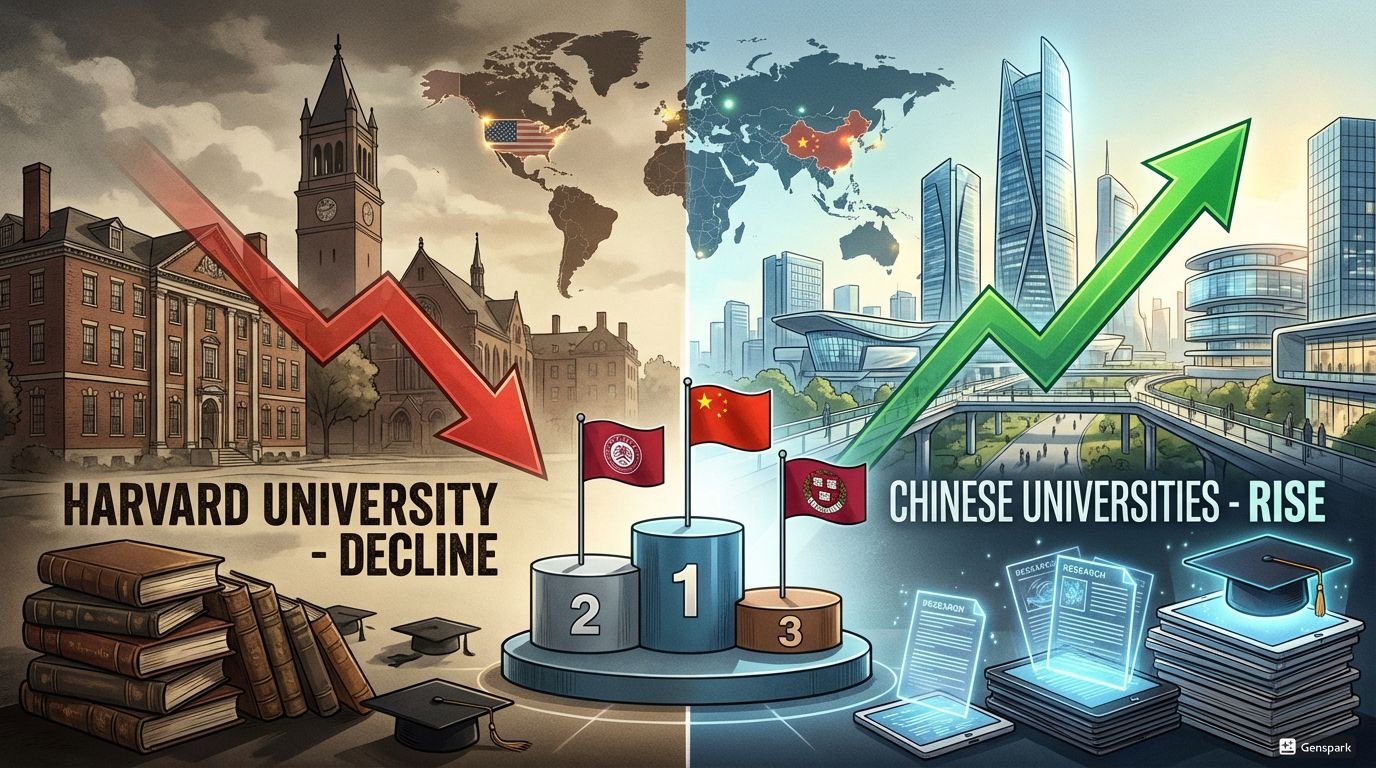
According to the latest data cited by the New York Times, Zhejiang University and Shanghai Jiao Tong University now rank above Harvard University, pushing the world’s most iconic institution to third place in research output. Even more striking is the broader picture: Chinese universities occupy the majority of the top ten positions, a space once dominated almost entirely by American and British institutions.
This development is historically significant. It marks the first time that Western universities; particularly those in the United States — have lost clear leadership in the core domain of academic research production.
Beyond One Ranking: A Systemic Rise
The Leiden data is not an outlier. Other global assessments reinforce the same conclusion. The Center for World University Rankings (CWUR) reported in 2025 that China now has more universities ranked among the world’s top 2,000 than the United States, a milestone that would have seemed improbable even a decade ago.
Meanwhile, rankings such as Times Higher Education (THE) and QS World University Rankings, which incorporate teaching quality and global reputation, show steady upward movement by Chinese institutions such as Tsinghua University and Peking University. While Oxford, Cambridge, MIT, and Stanford remain prestigious, their dominance is increasingly shared rather than absolute.
Why China Is Advancing
China’s rise is neither accidental nor organic. It is the outcome of deliberate, long-term state policy. Massive public investment in universities, aggressive funding for research laboratories, incentives for international publication, and close collaboration between academia and industry have transformed Chinese universities into global research engines.
Equally important is scale. China produces tens of thousands of PhDs annually in science, technology, engineering, and medicine, feeding a research ecosystem that now rivals — and in volume surpasses — that of the United States and the United Kingdom.
Western Slowdown, Not Collapse
It would be misleading to interpret this shift as the decline of Western education. American and British universities remain leaders in innovation, liberal arts, and academic freedom. However, the New York Times report rightly notes that reduced public funding, restrictive immigration policies, and growing political pressures have slowed research momentum in the United States.
In a world where knowledge production increasingly defines economic and geopolitical power, even a relative slowdown has global consequences.
Implications for the Global South and Pakistan
For Pakistan and other developing nations, China’s academic ascent offers important lessons. It demonstrates that global academic leadership is not culturally fixed, but policy-driven. Sustained investment, institutional autonomy, and international engagement can reposition national universities within a generation.
Pakistan’s higher education system, while expanding, remains under-resourced and under-integrated into global research networks. The Chinese experience highlights what is possible when education is treated as a strategic national priority rather than a residual budget item.
A New Academic Order
The evidence is clear. China has emerged as a leading force in global university education and research, narrowing, and in some areas surpassing the long-standing lead of the United States and the United Kingdom. This does not signal the end of Western excellence, but it does mark the end of Western exclusivity.
The world is entering a multipolar academic era, and China is no longer catching up; it is setting the pace.
READ MORE
Leave a Reply