Category: Emerging Tech

  • Systems Limited to Acquire BAT’s IT Services Arm in Strategic Expansion Move

    Systems Limited to Acquire BAT’s IT Services Arm in Strategic Expansion Move

    The acquisition, approved in a Board meeting held on July 29, 2025, marks a significant diversification of Systems Limited’s service portfolio into IT-led shared and digital business services. These include consumer and customer services, omnichannel contact center operations, marketing, human resources, finance, procurement, and supply chain solutions across various geographies — aligning with the company’s core focus on business process outsourcing (BPO).

    A Share Purchase Agreement was also approved the same day, laying down the terms and conditions of the acquisition, which remains subject to applicable regulatory approvals and the fulfillment of all precedent conditions.

    Additionally, Systems Limited’s UAE-based associated company, Techvista Systems FZ LLC, has entered into a long-term Master Services Agreement with Accenture (UK) Limited. The agreement, signed on July 29, 2025, involves the provision of AI-powered global shared services through the newly acquired entity, further deepening the company’s footprint in advanced IT and outsourcing services.

    This acquisition underscores Systems Limited’s commitment to growing its international operations and strengthening its position in the digital transformation and BPO landscape. – ER News Desk

  • Zarea Launches Wholly Owned Subsidiary in UAE to Accelerate Global Expansion

    Zarea Launches Wholly Owned Subsidiary in UAE to Accelerate Global Expansion

    In a significant move toward international expansion, Zarea Limited has announced the successful incorporation of its wholly owned subsidiary in the United Arab Emirates (UAE) under the name Zarea Commerce FZCO.  
    According to a notice submitted to the Pakistan Stock Exchange (PSX), the newly formed entity will be based in Dubai and serve as Zarea’s regional headquarters. This strategic development is part of the company’s long-term growth strategy aimed at strengthening its presence in international markets, accelerating export-led growth, and enhancing its role in technology-driven B2B trade.  
    “With the launch of our regional base in Dubai, Zarea is now well-positioned to expand its footprint globally and unlock new market opportunities,” the company stated.  


    The move also underscores Zarea’s commitment to digitization, export facilitation, and establishing deeper commercial links across borders. The company highlighted that this initiative aligns with its mission to support overseas operations, and it marks a milestone in Zarea’s ambition to become a prominent player in global commerce.  
    📌 Subsidiary Details:  
    Name: Zarea Commerce FZCO  
    Place of Incorporation: Dubai, United Arab Emirates  
    Ownership: 100% owned by Zarea Limited  
    The company’s Board of Directors expressed confidence that the establishment of Zarea Commerce FZCO will accelerate Zarea’s long-term value creation and deliver sustained benefits for shareholders. The company assured it will keep shareholders and the exchange informed of any future material developments as per regulatory guidelines. – ENGINEERING REVIEW

  • Pakistan’s Ambitious Digital Transformation Could Redefine Economic and Social Landscape: ADB

    Pakistan’s Ambitious Digital Transformation Could Redefine Economic and Social Landscape: ADB

    Pakistan’s ambitious digital transformation agenda has the potential to redefine its economic and social trajectory, according to a recent report by the Asian Development Bank (ADB).  
    “By harnessing digital technologies, the government can drive sustainable economic growth, increase the tax-to-gross domestic product (GDP) ratio, grow exports, boost foreign direct investment, enhance social services, and improve governance — all while reducing costs and increasing efficiency,” states the report “Pakistan’s Digital Ecosystem: A Diagnostic Report.”  
    The ADB emphasizes that Pakistan can bypass traditional stages of socioeconomic development by fully leveraging digital innovations. These technologies, it notes, are key to boosting GDP, expanding exports, attracting foreign investment, and improving service delivery — while simultaneously cutting public sector costs and enhancing operational efficiency.  
    According to the report, digital transformation holds the key for Pakistan to leap forward. Technologies such as mobile banking and digital payments could significantly improve financial inclusion and support entrepreneurship, particularly among underserved and rural populations.


    The report also highlights the transformative potential of digitalization beyond the technology sector. In agriculture, manufacturing, and services, digital tools are enabling greater productivity and innovation. These shifts are not only creating new business opportunities but also generating employment across the wider economy.  
    Education and healthcare are also set for a digital overhaul. E-learning platforms and telemedicine services are seen as vital for bridging infrastructure gaps, especially in remote areas. Simultaneously, e-governance initiatives are being credited with improving transparency, efficiency, and citizen engagement.  
    Currently, Pakistan’s digital sector contributes around 1.5% to national GDP. However, its indirect benefits across other sectors are substantial, making it a cornerstone of the country’s sustainable development efforts.  
    Pakistan’s digital landscape is rapidly evolving, driven by mobile technology, cloud-based systems, and automation. In a major legislative move, the Digital Nation Pakistan Act 2025 was enacted earlier this year, establishing the Pakistan Digital Authority to oversee national digital governance and innovation.  
    A key feature of the new legislation is the creation of the National Digital Commission (NDC) — chaired by the Prime Minister and the four provincial chief ministers.  
    The NDC will guide the strategic direction of Pakistan’s digital transformation, ensuring alignment across federal and provincial efforts. Its mandate includes enhancing digital literacy, strengthening governance, and positioning Pakistan as a competitive player in the global digital economy.  
    The ADB’s report sends a clear message: with effective implementation and sustained investment, Pakistan’s digital transformation could be a game-changer — unlocking new opportunities for economic growth and social equity.— APP

  • China’s open-source AI models ‘very advanced’, says Nvidia CEO, as H20 chip sales resume

    China’s open-source AI models ‘very advanced’, says Nvidia CEO, as H20 chip sales resume

    Open source allows not just the contribution of each company but the combined resource of an ecosystem, which is what was “very clever about open source engineering here in China”, Huang said at the China International Supply Chain Expo.

    DeepSeek’s models, Alibaba Group Holding’s Qwen and Chinese start-up Moonshot’s Kimi were “the best open reasoning models in the world today,” and were “very advanced”, Huang said during a fireside chat with Wang Jian, founder of Alibaba Cloud, the Chinese e-commerce giant’s AI and cloud unit.

    While Huang praised the “open source” movement in China, he also highlighted the global implications of the approach whereby companies share their research and collaborate to advance artificial intelligence technology.

    “Don’t forget that open source has many global implications. Not only did the open source models help the Chinese ecosystem, [they are] helping ecosystems around the world,” Huang said.

    Huang added that different kinds of companies – in areas such as fintech, healthcare and robotics – would be able to take advantage of open models.

    Huang is on his third trip to China this year, attending the expo after Nvidia announced earlier this week that it had received Washington’s approval to resume shipping the H20, an AI graphics processing unit (GPU) tailor made for the Chinese market to comply with US export restrictions.

    Despite being less powerful than other advanced Nvidia chips such as the H100, it remains the top option for Chinese firms and was in high demand before the US restricted its sales in April.

    The recovery of a supply chain takes time, and it currently takes Nvidia about nine months from the placement of wafer orders to the delivery of finished computing products, Huang told Chinese media outlets on Wednesday.

    “We are working at full speed to restore the production capacity for Hopper architecture products, but this indeed requires sustained efforts,” Huang reportedly said.

    Chinese companies have not yet been able to place orders for the H20 because US government agencies were still processing the approvals, according to Huang. Nvidia said earlier this week that the US government had “assured” the company that licences would be granted to allow export of the H20 GPUs to China.

    The availability of Nvidia’s H20 would “ease the anxiety” of domestic firms that were building large language models, and boost the share of foreign chip suppliers in China, analysts said. – SCMP

  • China-tied AI tools like DeepSeek face US federal ban over ‘threat’

    China-tied AI tools like DeepSeek face US federal ban over ‘threat’

    Titled the “No Adversarial AI Act”, the proposed legislation aims to prohibit federal agencies from procuring or deploying AI technologies developed in China, Russia, Iran and North Korea.

    The bill was introduced in the House by US congressman John Moolenaar, a Michigan Republican who chairs the House Select Committee on the Chinese Communist Party, and Raja Krishnamoorthi of Illinois, the panel’s senior Democrat.

    Rick Scott, a Florida Republican, and Gary Peters, a Michigan Democrat, introduced the companion legislation in the Senate.

    “Artificial intelligence controlled by foreign adversaries poses a direct threat to our national security, our data and our government operations,” Krishnamoorthi said in a statement.

    “We cannot allow hostile regimes to embed their code in our most sensitive systems. This bipartisan legislation will create a clear firewall between foreign adversary AI and the US government, protecting our institutions and the American people.”

    Chinese AI systems, Krishnamoorthi added, “do not belong on government devices” and “shouldn’t be entrusted with government data”.

    The act requires the government to maintain a public list of AI models developed by foreign adversaries, updated every 180 days, with limited exemptions for research or critical functions.

    Federal agencies would also be barred from buying or deploying those tools unless approved by the head of an executive agency, with written notice to both Congress and the Office of Management and Budget.

    Exemptions may be granted for specific purposes such as academic research, but they would be tightly controlled.

    The bill, which appears largely to be targeting China’s AI giant DeepSeek, came as Washington accused the company of harbouring close ties with the country’s Communist Party and carrying out technology theft from America.

    DeepSeek has allegedly supported China’s military and intelligence operations while gaining access to significant quantities of advanced Nvidia chips, Reuters reported earlier this week, citing a senior State Department official.

    Moolenaar in Wednesday’s statement described AI as “the strategic technology” at the centre of a “new cold war”, referring to the Sino-American tech rivalry.

    “The CCP doesn’t innovate – it steals, scales and subverts. From IP theft and chip smuggling to embedding AI in surveillance and military platforms, the Chinese Communist Party is racing to weaponise this technology.”

    “We must draw a clear line: US government systems cannot be powered by tools built to serve authoritarian interests,” Moolenaar added.

    “The select committee is taking action to block CCP-linked AI from infiltrating US government systems,” the House panel posted on social media on Wednesday shortly after the bill’s introduction.

    The act “would ban AI tools tied to the Chinese Communist Party, like DeepSeek, from federal use, protecting national security from Beijing’s digital authoritarianism”, it added.

    Liu Pengyu, a spokesperson for Beijing’s embassy in the US, called Congress’ allegations of Chinese technology theft “nothing but slander and smears”.

    “China actively promotes innovation in artificial intelligence, and places high importance on AI safety and ethics,” Liu said in an emailed response to questions.

    He described the Congress’ move as “the abuse of national security concepts to politicise trade and technology issues”, adding that China firmly opposes America’s “malicious suppression and containment” of China’s AI industry.

    With DeepSeek leading the charge, China’s AI sector has expanded rapidly despite sweeping US restrictions aimed at curbing its access to advanced technologies.

    Its cost-efficient model, seen as a rival to ChatGPT, shook US markets earlier this year and triggered a sharp sell-off in tech stocks.

    Amid growing concerns over data security, several US companies and government agencies have already barred the use of DeepSeek. The Donald Trump administration is weighing a broader federal ban of the platform across government devices.

    In a hearing of the select committee earlier on Wednesday, Krishnamoorthi warned that “DeepSeek is sending our data straight into the hands of the CCP”, adding that “as AI continues to get more powerful, the risks only grow greater”.

    In recent years, several US bills have been introduced to restrict the use of Chinese AI technologies.

    In February, US congressmen Josh Gottheimer, a New Jersey Democrat, and Darin LaHood, an Illinois Republican, introduced the “No DeepSeek on Government Devices Act”. It directed federal agencies to remove the app from use in law enforcement and national security matters.

    The Senate last month introduced its own legislation to block Chinese AI, including the “Decoupling America’s AI Capabilities from China Act”. – South China Morning Post/The Star

  • Should the Public Challenge the ‘Good AI’ Myth Pushed by Tech Companies?

    Should the Public Challenge the ‘Good AI’ Myth Pushed by Tech Companies?

    This “good AI” myth is a key tool used by tech companies to promote their products. Yet there’s evidence that consumers are wary of the presence of AI in some products. This means that positive promotion of AI may be putting unwanted pressure on people to accept the use of AI in their lives.

    AI is becoming so ubiquitous that people may be losing their ability to say no to using it. It’s in smartphones, smart TVs, smart speakers like Alexa and virtual assistants like Siri. We’re constantly told that our privacy will be protected. But with the personal nature of the data that AI has access to in these devices, can we afford to trust such assurances?

    Some politicians also propagate the “good AI” promise with immense conviction, mirroring the messages coming from tech companies.

    My current research is partly explained in a new book called The Myth of Good AI. This research shows that the data feeding our AI systems is biased, as it often over-represents privileged sections of the population and mainstream attitudes.

    This means that any AI products that don’t include data from marginalized people, or minorities, might discriminate against them. This explains why AI systems continue to be riddled with racism, ageism and various forms of gender discrimination, for instance.

    The speed with which this technology is impinging on our everyday life makes it very hard to properly assess the consequences. And an approach to AI that is more critical of how it works does not make for good marketing for the tech companies.

    Power structures
    Positive ideas about AI and its abilities are currently dominating all aspects of AI innovation. This is partly determined by state interests and by the profit margins of the tech companies.

    These are tied into the power structures held up by tech multi-billionaires, and, in some places, their influence on governments. The relationship between Donald Trump and Elon Musk, despite its recent souring, is a vivid manifestation of this.

    And so, the public is at the receiving end of a distinctly hierarchical top-down system, from the big tech companies and their governmental enablers to users. In this way, we are made to consume, with little to no influence over how the technology is used. This positive AI ideology is therefore primarily about money and power.

    As it stands, there is no global movement with a unifying manifesto that would bring together societies to leverage AI for the benefit of communities of people, or to safeguard our right to privacy. This “right to be left alone,” codified in the US constitution and international human rights law, is a central pillar of my argument. It is also something that is almost entirely absent from the assurances about AI made by the big tech companies.

    Yet, some of the risks of the technology are already evident. A database compiling cases in which lawyers around the world used AI, identified 157 cases in which false AI-generated information—so-called hallucinations—skewed legal rulings.

    Some forms of AI can also be manipulated to blackmail and extort, or create blueprints for murder and terrorism.

    Tech companies need to program the algorithms with data that represents everyone, not just the privileged, in order to reduce discrimination. In this way, the public are not forced to give into the consensus that AI will solve many of our problems, without proper supervision by society. This distinction between the ability to think creatively, ethically and intuitively may be the most fundamental faultline between human and machine.

    It’s up to ordinary people to question the good AI myth. A critical approach to AI should contribute to the creation of more socially relevant and responsible technology, a technology that is already trialed in torture scenarios, as the book discusses, too.

    The point at which AI systems would outdo us in every task is expected to be a decade or so away. In the meantime there needs to be resistance to this attack on our right to privacy, and more awareness of just how AI works. – TX/Conversation

  • Billions of login credentials have been leaked online, Cybernews researchers say

    Billions of login credentials have been leaked online, Cybernews researchers say

    WORLD

    According to a report published this week, Cybernews researchers have recently discovered 30 exposed datasets that each contain a vast amount of login information—amounting to a total of 16 billion compromised credentials. That includes user passwords for a range of popular platforms including Google, Facebook and Apple.

    Sixteen billion is roughly double the amount of people on Earth today, signaling that impacted consumers may have had credentials for more than one account leaked. Cybernews notes that there are most certainly duplicates in the data and so “it’s impossible to tell how many people or accounts were actually exposed.”

    It’s also important to note that the leaked login information doesn’t span from a single source, such as one breach targeting a company. Instead, it appears that the data was stolen through multiple events over time, and then compiled and briefly exposed publicly, which is when Cybernews reports that its researchers discovered it.

    Various infostealers are most likely the culprit, Cybernews noted. Infostealers are a form of malicious software that breaches a victim’s device or systems to take sensitive information.

    Many questions remain about these leaked credentials, including whose hands the login credentials are in now. But, as data breaches become more and more common in today’s world, experts continue to stress the importance of maintaining key “cyber hygiene.”

    If you’re worried about your account data potentially being exposed in a recent breach, the first thing you can do is change your password—and avoid using the same or similar login credentials on multiple sites. If you find it too hard to memorize all your different passwords, consider a password manager or passkey. And also add multifactor authentication, which can serve as a second layer of verification through your phone, email or USB authenticator key. – TX

  • Websites are tracking you via browser fingerprinting, researchers show

    Websites are tracking you via browser fingerprinting, researchers show

    The findings are published as part of the Proceedings of the ACM on Web Conference 2025.

    “Fingerprinting has always been a concern in the privacy community, but until now, we had no hard proof that it was actually being used to track users,” said Dr. Nitesh Saxena, cybersecurity researcher, professor of computer science and engineering and associate director of the Global Cyber Research Institute at Texas A&M. “Our work helps close that gap.”

    When you visit a website, your browser shares a surprising amount of information, like your screen resolution, time zone, device model and more. When combined, these details create a “fingerprint” that’s often unique to your browser. Unlike cookies—which users can delete or block—fingerprinting is much harder to detect or prevent. Most users have no idea it’s happening, and even privacy-focused browsers struggle to fully block it.

    “Think of it as a digital signature you didn’t know you were leaving behind,” explained co-author Zengrui Liu, a former doctoral student in Saxena’s lab. “You may look anonymous, but your device or browser gives you away.”

    This research marks a turning point in how computer scientists understand the real-world use of browser fingerprinting by connecting it with the use of ads.

    “While prior works have studied browser fingerprinting and its usage on different websites, ours is the first to correlate browser fingerprints and ad behaviors, essentially establishing the relationship between web tracking and fingerprinting,” said co-author Dr. Yinzhi Cao, associate professor of computer science and technical director of the Information Security Institute at Johns Hopkins University.

    To investigate whether websites are using fingerprinting data to track people, the researchers had to go beyond simply scanning websites for the presence of fingerprinting code. They developed a measurement framework called FPTrace, which assesses fingerprinting-based user tracking by analyzing how ad systems respond to changes in browser fingerprints.

    This approach is based on the insight that if browser fingerprinting influences tracking, altering fingerprints should affect advertiser bidding—where ad space is sold in real time based on the profile of the person viewing the website—and HTTP records—records of communication between a server and a browser.

    “This kind of analysis lets us go beyond the surface,” said co-author Jimmy Dani, Saxena’s doctoral student. “We were able to detect not just the presence of fingerprinting, but whether it was being used to identify and target users—which is much harder to prove.”

    The researchers found that tracking occurred even when users cleared or deleted cookies. The results showed notable differences in bid values and a decrease in HTTP records and syncing events when fingerprints were changed, suggesting an impact on targeting and tracking.

    Additionally, some of these sites linked fingerprinting behavior to backend bidding processes—meaning fingerprint-based profiles were being used in real time, likely to tailor responses to users or pass along identifiers to third parties.

    Perhaps more concerning, the researchers found that even users who explicitly opt out of tracking under privacy laws like Europe’s General Data Protection Regulation (GDPR) and California’s California Consumer Privacy Act (CCPA) may still be silently tracked across the web through browser fingerprinting.

    Based on the results of this study, the researchers argue that current privacy tools and policies are not doing enough. They call for stronger defenses in browsers and new regulatory attention to fingerprinting practices. They hope that their FPTrace framework can help regulators audit websites and providers who participate in such activities, especially without user consent.

    This research was conducted in collaboration with Johns Hopkins University and presented at the ACM Web Conference (WWW) 2025. – TX

  • Job interviews enter a strange new world with AI that talks back

    Job interviews enter a strange new world with AI that talks back

    Startups like Apriora, HeyMilo AI and Ribbon all say they’re seeing swift adoption of their software for conducting real-time AI interviews over video. Job candidates converse with an AI “recruiter” that asks follow-up questions, probes key skills and delivers structured feedback to hiring managers. The idea is to make interviewing more efficient for companies – and more accessible for applicants – without requiring recruiters to be online around the clock.

    “A year ago this idea seemed insane,” said Arsham Ghahramani, co-founder and chief executive officer of Ribbon, a Toronto-based AI recruiting startup that recently raised US$8.2mil (RM34.81mil) in a funding round led by Radical Ventures. “Now it’s quite normalised.”

    Employers are drawn to the time savings, especially if they’re hiring at high volume and running hundreds of interviews a day. And job candidates – especially those in industries like trucking and nursing, where schedules are often irregular – may appreciate the ability to interview at odd hours, even if a majority of Americans polled last year by Consumer Reports said they were uncomfortable with the idea of algorithms grading their video interviews.

    At Propel Impact, a Canadian social impact investing nonprofit, a shift to AI screener interviews came about because of the need to scale up the hiring process. The organisation had traditionally relied on written applications and alumni-conducted interviews to assess candidates. But with plans to bring on more than 300 fellows this year, that approach quickly became unsustainable.

    At the same time, the rise of ChatGPT was diluting the value of written application materials. “They were all the same,” said Cheralyn Chok, Propel’s co-founder and executive director. “Same syntax, same patterns.”

    Technology allowing AI to converse with job candidates on a screen has been in the works for years. Companies like HireVue pioneered one-way, asynchronous video interviews in the early 2010s and later layered on automated scoring using facial expressions and language analysis – features that drew both interest and criticism. (The visual analysis was rolled back in 2020.) But those platforms largely left the experience static: candidates talking into a screen with no interaction, leaving recorded answers for a human to dissect after the fact.

    It wasn’t until the public release of large language models like ChatGPT in late 2022 that developers began to imagine – and build – something more dynamic. Ribbon was founded in 2023 and began selling its offering the following year. Ghahramani said the company signed nearly 400 customers in just eight months. HeyMilo and Apriora launched around the same time and also report fast growth, though each declined to share customer counts.

    “The first year ChatGPT came out, recruiters weren’t really down for this,” said HeyMilo CEO Sabashan Ragavan. “But the technology has gotten a lot better as time has gone on.”

    Even so, the rollout hasn’t been glitch-free. A handful of clips circulating on TikTok show interview bots repeating phrases or misinterpreting simple answers. One widely shared example involved an AI interviewer created by Apriora repeatedly saying the phrase “vertical bar pilates. .Aaron Wang, Apriora’s co-founder and CEO, attributed the error to a voice model misreading the term “Pilates”. He said the issue was fixed promptly and emphasised that such cases are rare.

    “We’re not going to get it right every single time,” he said. “The incident rate is well under 0.001%.”

    Chok said Propel Impact had also seen minor glitches, though it was unclear whether they stemmed from Ribbon itself or a candidate’s WiFi connection. In those cases, the applicant was able to simply restart.

    Braden Dennis, who has used chatbot technology to interview candidates for his AI-powered investment research startup FinChat, noted that AI sometimes struggles when candidates ask specific follow-up questions. “It is definitely a very one-sided conversation,” he said. “Especially when the candidate asks questions about the role. Those can be tricky to field from the AI.”

    Startups providing the technology emphasised their approach to monitoring and support. HeyMilo maintains a 24/7 support team and automated alerts to detect issues like dropped connections or failed follow-ups. “Technology can fail,” Ragavan said, “but we’ve built systems to catch those corner cases.”

    Ribbon has a similar protocol. Any time a candidate clicks a support button, an alert is triggered that notifies the CEO. “Interviews are high stakes,” Ghahramani said. “We take those issues really seriously.” And while the videos of glitches are a bad look for the sector, Ghahramani said he sees the TikToks making fun of the tools as a sign the technology is entering the mainstream.

    Candidates applying to FinChat, which uses Ribbon for its screener interviews, are notified up front that they’ll be speaking to an AI and that the team is aware it may feel impersonal.

    “We let them know when we send them the link to complete it that we know it is a bit dystopian and takes the ‘human’ out of human resources,” Dennis said. “That part is not lost on us.”

    Still, he said, the asynchronous format helps widen the talent pool and ensures strong applicants aren’t missed. “We have had a few folks drop out of the running once I sent them the AI link,” Dennis said. “At the end of the day, we are an AI company as well, so if that is a strong deterrent then that’s OK.”

    Propel Impact prepares candidates by communicating openly about its reasons for using AI in interviews, while hosting information sessions led by humans to maintain a sense of connection with candidates. “As long as companies continue to offer human touch points along the way, these tools are going to be seen far more frequently,” Chok said.

    Regulators have taken notice. While AI interview tools in theory promise transparency and fairness, they could soon face more scrutiny over how they score candidates – and whether they reinforce bias at scale. Illinois now requires companies to disclose whether AI is analysing interview videos and to get candidates’ consent, and New York City mandates annual bias audits for any automated hiring tools used by local employers.

    Though AI interviewing technology is mainly being used for initial screenings, Ribbon’s Ghahramani said 15% of the interviews on its platform now happen beyond the screening stage, up from just 1% a few months ago. This suggests customers are using the technology in new ways.

    Some employers are experimenting with AI interviews in which they can collect compensation expectations or feedback on the interview process – potentially awkward conversations that some candidates, and hiring managers, may prefer to see delegated to a bot.

    In a few cases, AI interviews are being used for technical evaluations or even to replace second-round interviews with a human. “You can actually compress stages,” said Wang. “That first AI conversation can cover everything from ‘Are you authorised to work here?’ to fairly technical, domain-specific questions.”

    Even as AI handles more of the hiring process, most companies selling the technology still view it as a tool for gathering information, not making the final call. “We don’t believe that AI should be making the hiring decision,” Ragavan said. “It should just collect data to support that decision.” – TS/Bloomberg

  • New AI Chip Modeled on Human Brain Eliminates Need for Cloud Computing

    New AI Chip Modeled on Human Brain Eliminates Need for Cloud Computing

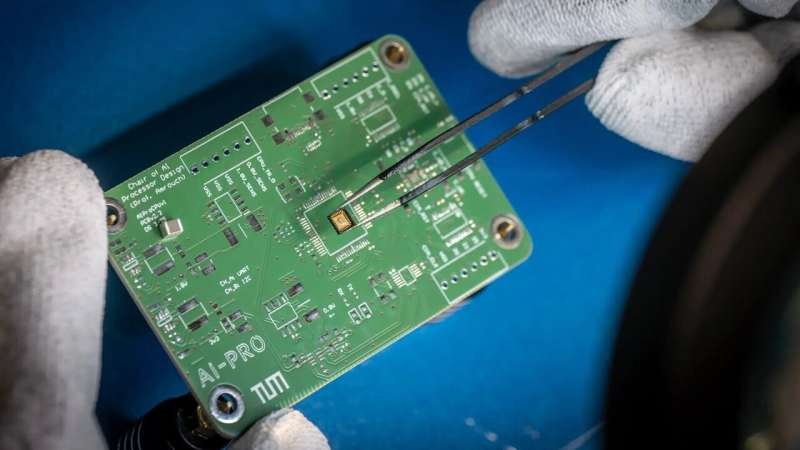
    The professor of AI processor design at TUM has already had the first prototypes produced by semiconductor manufacturer Global Foundries in Dresden. Unlike conventional chips, the computing and memory units of the AI Pro are located together. This is possible because the chip applies the principle of “hyperdimensional computing”: This means that it recognizes similarities and patterns, but does not require millions of data records to learn.

    Instead of being shown countless images of cars, as with the deep learning method used in conventional AI chips, this chip combines various pieces of information, such as the fact that a car has four wheels, usually drives on the road, and can have different shapes. Like the new chip, explains Prof. Amrouch, “humans also draw inferences and learn through similarities.”

    An important advantage of brain-like thinking: it saves energy. For the training of a sample task, the new chip consumed 24 microjoules, while comparable chips required 10 to 100 times more energy—”a record value,” notes Prof. Amrouch. “This mix of modern processor architecture, algorithm specialization and innovative data processing makes the AI chip something special.”

    This also sets it apart from all-rounders like the chips from industry giant NVIDIA. “While NVIDIA has built a platform that relies on cloud data and promises to solve every problem, we have developed an AI chip that enables customized solutions. There is a huge market there.”

    The research is under review for the European Solid-State Electronics Research Conference (ESSERC 2025).

    Neuromorphic chips: Modeled on the human brain
    The one-square-millimeter chip currently costs 30,000 euros. With about 10 million transistors it is not quite as densely packed or as powerful as NVIDIA chips with 200 billion transistors. But that is not Prof. Amrouch’s primary concern. His team specializes in AI chips that perform the processing directly on site instead of having to send the data to the cloud to be processed along with millions of other data sets before being sent back again. This saves time and server computing capacity and reduces the carbon footprint of AI.

    The chips are also customized for specific applications. “That makes them very efficient,” says chip expert Amrouch. For example, they focus on processing heart rate and other vital data collected via smartwatch or navigation data of a drone. Because this personal and sometimes sensitive data remains on board the device, issues with stable internet connections or cybersecurity do not even arise. “The future belongs to the people who own the hardware,” says Amrouch. – Courtesy TechXplore