Category: Featured

  • LinkedIn sued for disclosing customer information to train AI models

    LinkedIn sued for disclosing customer information to train AI models

    According to a proposed class action filed on Tuesday night on behalf of millions of LinkedIn Premium customers, LinkedIn quietly introduced a privacy setting last August that let users enable or disable the sharing of their personal data.

    Customers said LinkedIn then discreetly updated its privacy policy on Sept. 18, 2024 to say data could be used to train AI models, and in a “Frequently Asked Questions” hyperlink said opting out “does not affect training that has already taken place.”

    This attempt to “cover its tracks” suggests LinkedIn was “fully aware” it violated customers’ privacy, and its promise to use personal data only to support and improve its platform, to minimize public scrutiny and legal fallout, the complaint said.

    The lawsuit was filed in the San Jose, California, federal court on behalf of LinkedIn Premium customers who sent or received InMail messages, and whose private information was disclosed to third parties for AI training before Sept. 18.

    Meta backs data analytics firm Databricks as AI boom attracts investors

    It seeks unspecified damages for breach of contract and violations of California’s unfair competition law, and $1,000 per person for violations of the federal Stored Communications Act

    Microsoft did not immediately respond on Wednesday to requests for comment. A lawyer for the plaintiffs had no immediate additional comment.

    The lawsuit was filed several hours after U.S. President Donald Trump announced a joint venture among Microsoft-based OpenAI, Oracle and SoftBank, with a potential $500 billion of investment, to build AI infrastructure in the United States.

  • Meta backs data analytics firm Databricks as AI boom attracts investors

    Meta backs data analytics firm Databricks as AI boom attracts investors

    The Series J funding round closed on Wednesday and valued Databricks at $62 billion.

    The company also secured a $5.25 billion credit facility led by JPMorgan Chase alongside Barclays, Citi, Goldman Sachs, and Morgan Stanley.

    Founded in 2013, San Francisco-based Databricks offers a platform designed to help users ingest, analyze and build artificial intelligence applications using complex data from a variety of sources.

    Saudi Alwaleed’s KHC interested in TikTok if Musk or others buy it

    Investors are racing to pour money into AI-related startups after the meteoric success of OpenAI’s ChatGPT triggered a surge in corporate adoption of the technology.

    Sam Altman-led OpenAI raised $6.6 billion from investors in 2024.

    Companies, including Meta, have been investing heavily to build and train large language models (LLMs) such as ChatGPT, which are advanced AI systems designed to understand and generate human-like text.

    Databricks works closely with Meta’s Llama team. Llama is a family of open-source LLMs developed by the Facebook parent.

    How AI could help humans gain up to 10 years of life expectancy

    “Thousands of customers are using Llama on Databricks and we have been working closely with Meta on how to best serve those enterprise customers with Llama,” Databricks co-founder and CEO Ali Ghodsi said.

    “It naturally made sense for both parties to deepen that partnership through this investment.”

    More than 10,000 organizations, including Comcast, Block, Rivian and Shell, rely on the company’s Databricks Data Intelligence Platform to manage and analyze data for AI applications, according to its website.

  • Saudi Alwaleed’s KHC interested in TikTok if Musk or others buy it

    Saudi Alwaleed’s KHC interested in TikTok if Musk or others buy it

    The search to find a buyer for the Chinese-owned popular short-video app continues after it went dark and was revived later after U.S. President Donald Trump signed an executive order, opens new tab delaying the enforcement of a ban on it by 75 days.

    Human-inspired AI model can produce, understand vocal imitations of everyday sounds

    Trump said on Tuesday he was open to billionaire Musk buying the app if the Tesla (TSLA.O), opens new tab CEO wanted to do so.

    Al-Maiman, responding to a question by Saudi-owned Al Arabiya if KHC would be interested in TikTok in case Musk offered to buy it, said: “If Musk or others offered, we would have a desire to look into that investment, no doubt.”

    KHC already holds stakes in Musk’s social media platform X and his artificial intelligence startup xAI.

  • How AI could help humans gain up to 10 years of life expectancy

    How AI could help humans gain up to 10 years of life expectancy

    OpenAI has developed a new artificial intelligence model in collaboration with Retro Biosciences. It aims to extend life expectancy by studying Yamanaka factors, a set of proteins capable of reprogramming adult cells into pluripotent stem cells. This exclusive model, GPT-4b micro, has been designed to pave the way not only for the regeneration of different cell types, but also for the creation of customized organs in the best-case scenario.

    Also read: Human-inspired AI model can produce, understand vocal imitations of everyday sounds

    This model has been specially trained to offer optimal modifications of Yamanaka factors, the protein combinations essential for reprogramming cells into stem cells. The idea is that GPT-4b micro could make the cell reprogramming process much faster and more reliable than at present. All this research could, one day, open up new perspectives in the field of health and aging, and thus help to prolong the life of humans.

    Also read: Microsoft to invest $3bn in India to expand AI, cloud capacity

    For the moment, GPT-4b micro is only being used by Retro Biosciences and OpenAI on an experimental basis. No information has yet been released on whether the model will be made available to the public in the near future. Ultimately, the common denominator between OpenAI and Retro Biosciences is Sam Altman, co-founder and CEO of the former and investor in the latter. 

  • PEC forms ‘Coordination Committee’ with a majority of co-opted engineers as members

    PEC forms ‘Coordination Committee’ with a majority of co-opted engineers as members

    Engr. Abdul Qadir Shah is also the chief of the National Engineers Association (NEA), which broke its alliance with Engr. Najeeb Haroon and aligned with Engr. Nazir in the PEC Elections of 2024.

    What is special about this committee is that it is the very first committee built on non-GB or co-opted members, regardless of the fact that the majority of the committee are former GB members.

    The committee is comprised of:

    Engr. Syed Abdul Qadir Shah, Former Chairman, PEC (Chair)

    Engr. Dr. Salim Abid Tabassum, Ex-Vice Chancellor, Namal University, Mianwali (Co-Chair)

    Engr. Ghulam Usman Babai (PEC Governing Body)

    Engr. Dr. Mansoor Ahmed Baluch (Member, PEC Governing Body)

    Engr. Uzair Khan (Ex-DG, Peshawar Development Authority)

    Engr. Dr. Khadija Qureshi (MUET, Jamshoro)

    Engr. Dr. Attiq Ahmed (Member, PEC Governing Body)

    Engr. Syed Jawad Hussain Shah

    Engr. Abdur Rehman, Additional Registrar, who is the Secretary to the Committee.

    The Chairman, Engr. Nazir, has been avoiding forming committees comprising members outside the governing body and insisted he was busy reforming the council, which he believed would consume at least three months of his tenure to complete the initial work.

    Engr. Nazir has already formed over 13 committees, all based on governing body members, except for this one. Though not all committees are functioning, important committees have already begun meeting due to the regulatory responsibilities of the council.

    The friends and foes of the chairman have been pressing him to form traditional-style committees, in which co-opted members are also included—individuals who have worked for various groups of engineers to contest and win the elections.

    Chairman Nazir has looked at the justification for forming politically motivated committees differently and resisted pressure from his allies.

  • Pak Finance Minister invites investments in Agriculture, IT, Renewable Energy, Pharma sectors

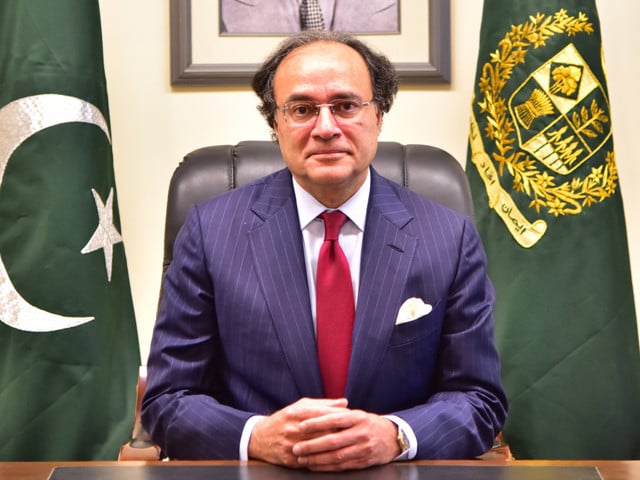
    Pak Finance Minister invites investments in Agriculture, IT, Renewable Energy, Pharma sectors

    In the article published on the World Economic Forum (WEF) website, the Minister highlights the transformative journey embarked upon by Pakistan in recent years towards economic stabilization and growth, according to a press release issued here on Tuesday.

    “Confronted with formidable challenges, we implemented decisive reforms to build a robust foundation for sustainable and inclusive development. Today, the results of these efforts are becoming evident, with the economy demonstrating resilience and renewed potential,” he says.

    Question on the series of economic reforms, he said “I assumed office as Finance Minister in 2024, Pakistan faced severe fiscal and monetary pressures and  inflation had surged to 38%, straining households and eroding purchasing power.”

    The Minister said that foreign exchange reserves had dropped dangerously low, barely covering two weeks of essential imports like food and fuel and industrial output had contracted by 10.3%, and GDP growth had plummeted to 0.2%.

    The compounded effects of COVID-19 and devastating floods causing over $30 billion in damages further tested our resilience.

    Recognizing the gravity of the situation, “we implemented a series of necessary reforms and these included stabilizing the exchange rate, tightening fiscal policies, and curbing inflation through targeted monetary interventions. With support from the IMF’s Extended Fund Facility (EFF) worth $7 billion, we initiated structural improvements in critical sectors such as energy and taxation. Central to this effort was “Uraan Pakistan”, an economic transformation plan launched in 2024,” he said.

    Watch WEF sessions: Industries in the Intelligent Age

    He said that this initiative aims to achieve sustainable, export-led 6% GDP growth by 2028 through public-private partnerships, enhanced export competitiveness and optimized public finances and priority sectors include agriculture, energy, textiles, pharmaceuticals and IT.

    Finance Minister said that a pivotal component of ‘Uraan Pakistan’ is our collaboration with the World Bank on a $20 billion initiative targeting health, education, poverty alleviation, investment and climate resilience.

    He said that this transformative partnership addresses critical challenges such as child malnutrition, educational outcomes and clean energy adoption.

    By integrating sustainability into our development framework, “we are contributing to global efforts to achieve the United Nations Sustainable Development Goals (SDGs)” he said.

    The Minister said that in July 2024, we introduced a reform-oriented budget with an ambitious goal of raising Rs13 trillion in revenue a 40% increase from the previous year.

    He said that these reforms focused on broadening the tax base by targeting under-taxed sectors like agriculture, real estate and trade, while leveraging technology to enhance compliance and transparency. Modernizing the Federal Board of Revenue (FBR) has been instrumental in streamlining tax administration.

    Meanwhile question on the economic revival in the country, he said that today, Pakistan’s economy is on a path to recovery and inflation has dropped to 4.1%, and foreign exchange reserves now provide over two months of import coverage.

    He said that goods exports have risen by 7.1%, and the IT sector has grown by an impressive 28% year-on-year. Pakistan’s global default risk has dropped by 93%, signaling renewed faith in the country’s fiscal stability.

    Local and foreign investors, including global giants like Aramco, BYD and Samsung, are contributing to this economic revival, reflecting Pakistan’s potential as a lucrative investment hub.

    Aurangzeb said that the current account has been in surplus for three consecutive months, and investor confidence is at a two-year high and foreign direct investment (FDI) has grown by 20% in the first half of fiscal year 2025, reflecting renewed trust in Pakistan’s economic trajectory.

    He said that initiatives like the ‘Roshan Digital Account’ have attracted over $9 billion in inflows, while remittances have reached a record $35 billion this year and additionally, Pakistan’s equity market delivered an 87% return in dollar terms, underscoring strong investor sentiment.

    Internationally, Pakistan’s progress has been acknowledged, with all three top global rating agencies upgrading the country’s sovereign ratings. Moody’s revised Pakistan’s economic outlook to ‘Positive’ in September 2024, recognizing the impact of our policy measure, he said.

    Talking on current economic challenges , he said that despite significant achievements, challenges remain and to break free from cycles of external assistance, Pakistan is addressing structural inefficiencies in revenue collection, energy, state-owned enterprises (SOEs) and privatization.

    He said that rightsizing the federal government, reforming SOEs, and fostering export-led growth will strengthen internal revenue streams and reduce reliance on international funding programmes.

    The Minister said that global stakeholders are invited to support Pakistan’s journey by investing in priority sectors such as agriculture, IT, renewable energy, mining and minerals, textiles and apparels, pharmaceuticals, while capitalizing on Special Economic Zones (SEZs).

    He said that Pakistan’s innovative approaches in taxation and economic stabilization offer valuable lessons for other developing economies and furthermore, partnerships in climate resilience and sustainable development are crucial for advancing shared global goals.

    Finance Minister said that the cornerstone of Pakistan’s economic transformation is political will and visionary leadership and this journey is not just about overcoming challenges but about harnessing resilience, determination and collective effort.

    He said that with a remarkable workforce, abundant natural resources, and immense production potential, Pakistan is poised to soar to new heights – contributing to regional stability and global economic progress.

  • Greenpeace Activists Slip Through Davos Security To Stage Climate Protest

    Greenpeace Activists Slip Through Davos Security To Stage Climate Protest

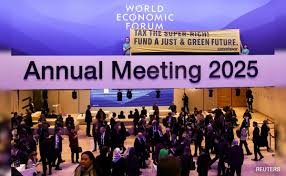
    Davos: Greenpeace activists evaded the World Economic Forum’s tight security checks on Tuesday, staging a brief climate change protest outside the main hall of the annual meeting in Davos.

    Dressed up in dark suits and white shirts, three protesters made it into the Congress Centre and scaled a balcony. Two then unfurled a large banner saying: “Tax the super-rich. Fund a just & green future”.

    Security staff intervened and escorted the protesters away, shortly before the official opening ceremony and a speech by European Commission President Ursula von der Leyen.

    “The three activists have been taken away from the scene,” Greenpeace activist Clara Thompson later said by telephone. Asked how they had got inside the security cordon, Thompson said: “They had their ways and means, I can’t say any more.”

    The message to business and political leaders attending the meeting in Switzerland echoed another protest by Greenpeace on Monday, during which activists blocked the Davos heliport.

    Security is tight for the WEF meeting, where one of the main themes for discussion this week is “safeguarding the planet”.

    The WEF said on its 2025 program that it is “crucial for businesses, governments, and civil society to work together to find common solutions and take decisive action”.

    Demonstrators protesting over fossil fuel subsidies had also on Monday splattered paint green on the shop front where Amazon has set up a temporary base on the main street. –News Agencies/ERMD

  • A New Dawn for Reko Diq: Saudi Investment and Pakistan’s Mining Future

    A New Dawn for Reko Diq: Saudi Investment and Pakistan’s Mining Future

    It was a crisp winter morning in Riyadh, as the towering glass structures of the Saudi capital gleamed under the soft sunlight. Inside the grand hall of the Future Minerals Forum, global mining experts, executives, and government officials gathered to discuss the future of mineral resources and energy. Among them was Bandar Alkhorayef, Saudi Arabia’s Minister of Mining, who had a lot to share about his kingdom’s ambitions in the mining sector, particularly in Pakistan.  
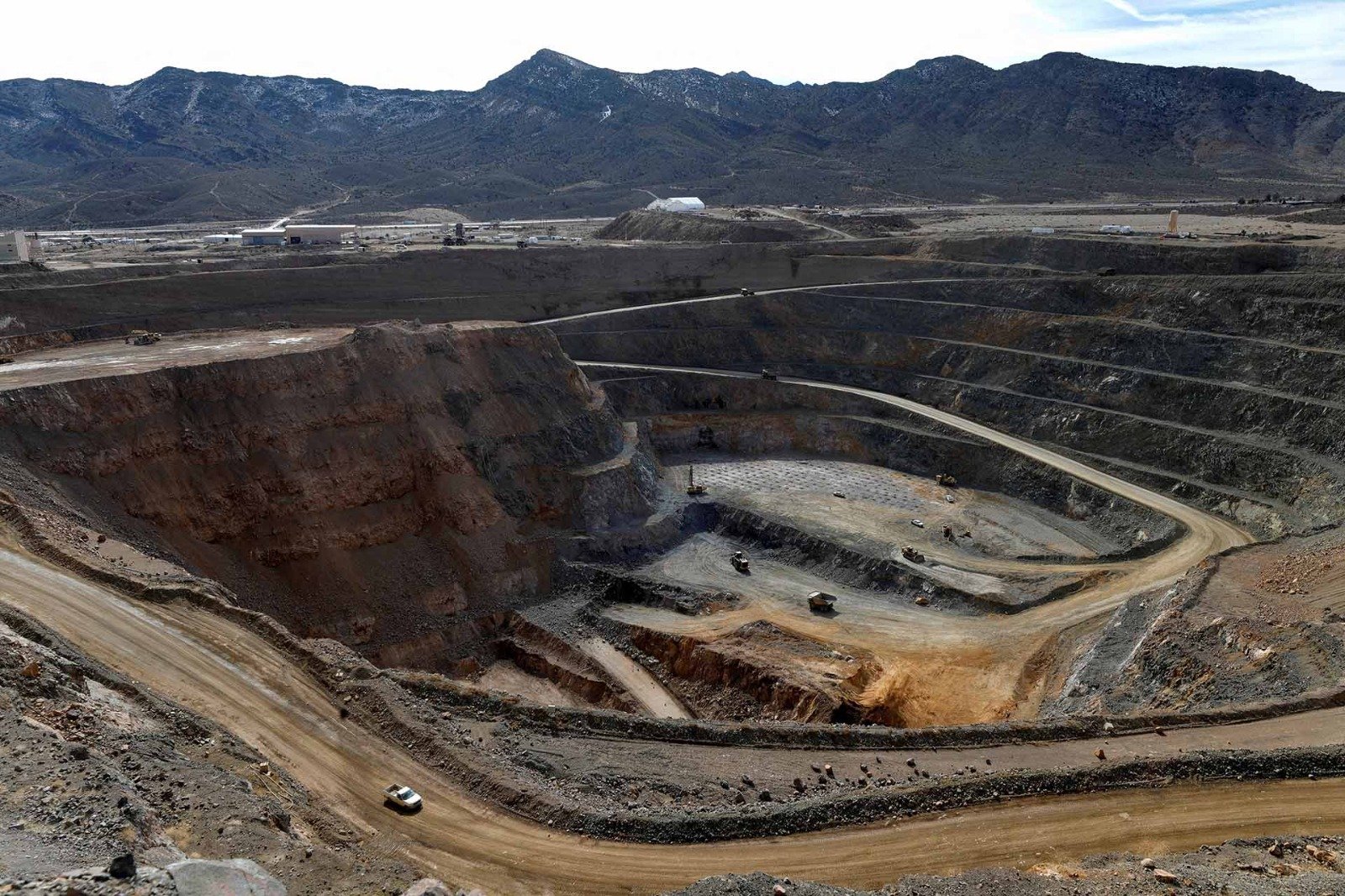
    Alkhorayef had just made a significant announcement that rippled through the mining industry: Saudi Arabia’s state-backed mining giant, Manara Minerals, was eyeing a $100 million investment in Pakistan’s mining infrastructure. The news came as a welcome surprise to many in Pakistan, who had long struggled with underdeveloped infrastructure in their mining sector. The focus was on the vast copper and gold reserves of Reko Diq, a mine regarded as one of the world’s largest underdeveloped mineral deposits.  
    “We are looking to help Pakistan with infrastructure projects that will make the mining deals more viable,” Alkhorayef explained in an interview with Reuters. “The lack of proper infrastructure has hindered many potential mining ventures here. Through the Saudi Development Fund, we aim to provide financing solutions to make this possible.”  
    The announcement aligned with Pakistan’s growing optimism regarding foreign investments in its mineral resources, particularly the Reko Diq mine, which had been at the center of a legal and financial dispute for years. The mine, once a dream for many in the country’s mining industry, had the potential to transform the economy.  


    Just a day earlier, Pakistan’s Petroleum Minister, Musadik Malik, had expressed similar optimism. “I’m very hopeful that in the next quarter or two we will have very big announcements,” Malik had said. He was referring to a series of copper-related developments at Reko Diq and other nearby mines. “So we’re very hopeful that this year, we will make some big announcements.”  
    Minister Malik’s confidence was not without foundation. Back in May, executives from Manara Minerals had visited Pakistan to explore potential partnerships. The kingdom’s interest in Reko Diq wasn’t just about copper and gold; it was about securing a foothold in one of the most coveted mining regions in the world. For Saudi Arabia, it was part of a broader strategy to diversify its economy away from oil dependency.  
    Manara Minerals, a joint venture between Ma’aden, Saudi Arabia’s state-controlled mining company, and the Public Investment Fund (PIF) – which manages a staggering $925 billion in assets – was created to take on ambitious international ventures. As part of Saudi Vision 2030, the kingdom’s plan to transition its economy, the partnership with Pakistan was a pivotal step.  
    “I am confident this partnership will bring prosperity to both countries,” Malik added. “The Saudi investment could revitalize Reko Diq and potentially expand operations to other mineral-rich areas in the region.”  
    The deal was still in the works, but as the Future Minerals Forum in Riyadh continued, there was a tangible sense of momentum. For Pakistan, this development was a glimmer of hope amidst ongoing economic struggles. The promise of Saudi investment brought not only financial capital but technical expertise that the Pakistani mining sector had long lacked.  
    In the broader context of mining in the region, another announcement had caught the attention of industry leaders. Saudi Aramco, the oil giant, had begun a promising lithium extraction project in partnership with King Abdullah University for Science and Technology (KAUST). Lithium, a key component in the batteries of electric vehicles, laptops, and smartphones, was quickly becoming one of the world’s most sought-after minerals. Aramco’s interest in this emerging market further showcased the kingdom’s commitment to diversifying its economy beyond oil.  
    Yet, even as Saudi Arabia and Pakistan were entering an exciting phase of cooperation, challenges remained. The Reko Diq mine, despite its immense potential, was far from commercially viable without substantial investment in infrastructure, both logistical and technological. This was where the Saudi Development Fund’s role became crucial. The kingdom’s deep pockets and financial expertise would be vital in turning the mine into an operational success.  
    Over the coming months, a flurry of negotiations and agreements between Manara Minerals, the government of Pakistan, and local stakeholders began to take shape. There was talk of a joint venture agreement that would see the kingdom’s mining giant gain access to Reko Diq, as well as other untapped deposits in the region. The deal would include not just extraction operations but also significant upgrades to local infrastructure: roads, power grids, and transportation networks necessary to bring the mine into full production.  
    In the corridors of power in Islamabad, excitement was palpable. With foreign investment on the horizon, officials began to reimagine Pakistan’s role in the global mining landscape. For decades, the country’s mineral wealth had remained largely untapped, hidden beneath layers of bureaucracy and economic stagnation. The potential for change was immense, and the future of Reko Diq was now intertwined with Saudi Arabia’s ambitious vision for diversification and global partnerships.  
    As the months rolled by, the first major announcements came through. Manara Minerals confirmed it would be taking a significant stake in the Reko Diq project, a milestone that would open the door to an influx of capital and technology. The copper and gold reserves of Reko Diq were no longer a distant dream – they were becoming a reality.  
    By 2027, when commercial production of lithium from Aramco’s pilot project was expected to begin, Saudi Arabia and Pakistan were not just collaborators in mining; they were emerging as major players in the global energy transition. The partnership, forged in the corridors of Riyadh, had the potential to reshape the future of mineral extraction in the region and beyond.  
    For Pakistan, the road ahead seemed brighter than ever. With Saudi investment and technological expertise, the mining sector was on the verge of a new era. And for Saudi Arabia, Reko Diq and its vast reserves represented not just a financial opportunity but a key component of the kingdom’s journey toward a more diversified, sustainable economy. Together, the two nations stood on the precipice of a mining renaissance, one that would shape the future for decades to come.– ER  

  • Global study shows majority of 18-34 year olds support using violence and disinformation to drive change

    Global study shows majority of 18-34 year olds support using violence and disinformation to drive change

    The survey of the 33,000 respondents across 28 countries showed severe levels of distrust in government and business, with many respondents viewing them as serving the narrow interests of the wealthy while regular people struggle.

    It was released as the World Economic Forum annual meeting in Davos was set to kick off under the theme “Collaboration for the Intelligent Age.”

    Four in 10 respondents approved of hostile acts to bring about change, including violence or threats, online attacks, intentionally spreading disinformation and damaging property, the survey showed.

    Among respondents aged 18 to 34, support for hostile actions was even higher at 53%.

    The results are “profound,” said the firm’s CEO Richard Edelman. “We’ve now seen a slide over a 10-year period from fears, to polarization to grievance,” as the public becomes more anxious about the cost of living and job security tied to artificial intelligence, he said.

    Discontent stems from a lack of hope for the next generation, class divides among low- and high-income people, distrust in leaders including government officials, business executives and journalists, and confusion over credible information, the survey showed.

    In Western democracies, respondents’ outlook for their countries being better for the next generation dropped to severe lows of 9% in France, 17% in the UK and 30% in the U.S., the survey found.

    “Moving back from a grievance-based society will require a cross-institution effort to address issues like information integrity, affordability, sustainability, and the future of AI,” Edelman said.

    About Edelman

  • TikTok stops working for US users

    TikTok stops working for US users

    “A law banning TikTok has been enacted in the U.S. Unfortunately, that means you can’t use TikTok for now. We are fortunate that President Trump has indicated that he will work with us on a solution to reinstate TikTok once he takes office. Please stay tuned,” a message on the app said.