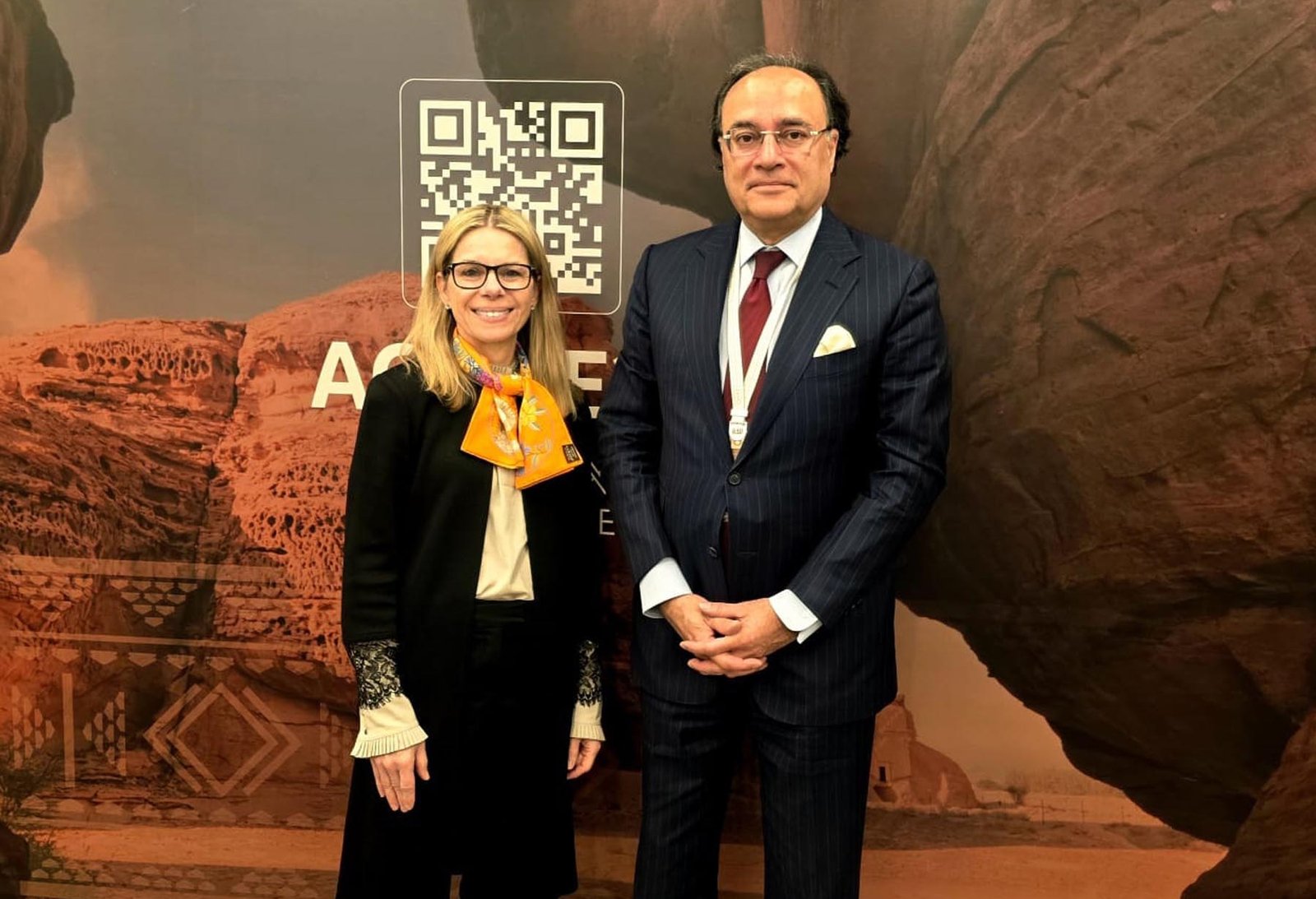
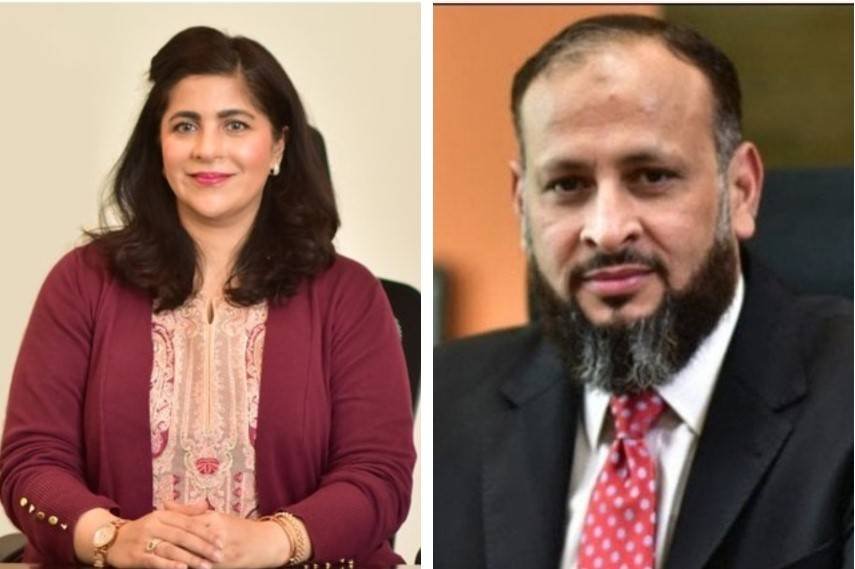
Federal Minister for Finance and Revenue, Senator Muhammad Aurangzeb, held a meeting with Ms. Anna Bjerde, Managing Director of the World Bank Group, on the sidelines of the Annual AlUla Conference for Emerging Market Economies in the Kingdom of Saudi Arabia.
During the meeting, both sides followed up on the recent visit of the World Bank President to Pakistan and reviewed progress under the Country Partnership Framework (CPF). They also discussed the way forward to further strengthen development cooperation.
The discussion covered priority sectors including energy, education, health, climate resilience, debt-for-development swaps, fiscal reforms, and infrastructure development. Emphasis was placed on adopting a more focused approach, introducing clear performance trackers, and ensuring robust implementation mechanisms to translate commitments into tangible outcomes.
Ms. Anna Bjerde reaffirmed the World Bank Group’s strong commitment to Pakistan’s ten-year development programme worth USD 20 billion, underscoring continued support for the country’s reform and development agenda. She highlighted the importance of sustained engagement and effective execution to maximize the programme’s developmental impact.
Senator Aurangzeb reiterated the Government of Pakistan’s commitment to close collaboration with the World Bank Group and assured full cooperation through relevant federal ministries. He also stressed the role of provincial governments in ensuring better coordination, timely execution, and delivery of measurable results.
The AlUla Conference for Emerging Market Economies, launched in 2025, brings together finance ministers, central bank governors, senior policymakers, leaders of international financial institutions, and experts from around the world to deliberate on key economic challenges and opportunities facing emerging markets. – ER News Desk
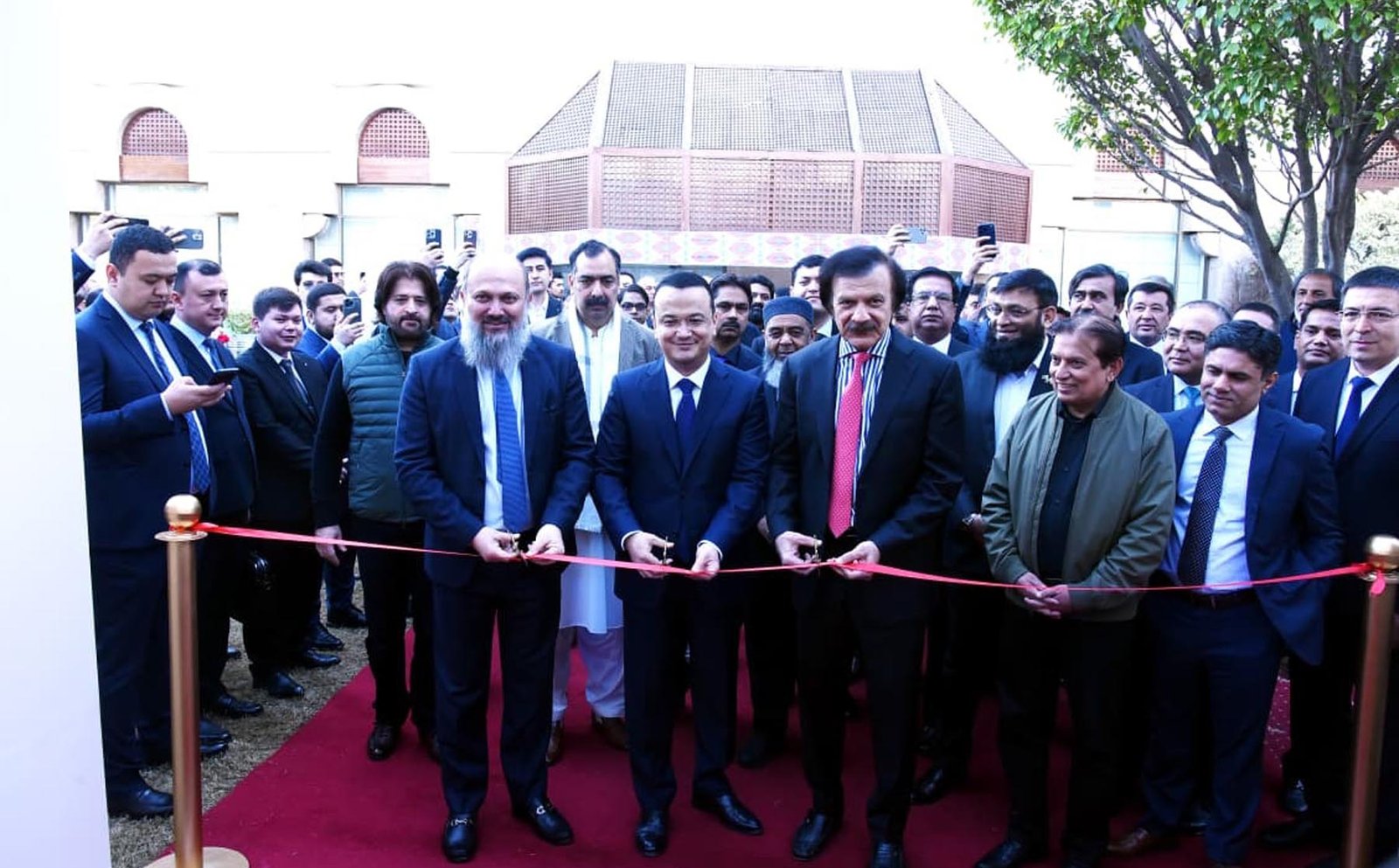
Federal Minister for Commerce Jam Kamal Khan inaugurated the Made in Uzbekistan Exhibition on the sidelines of the Pakistan–Uzbekistan Business Forum in Islamabad, reaffirming Pakistan’s resolve to strengthen bilateral trade, industrial cooperation, and private-sector engagement with Uzbekistan.
The ceremony was attended by the Uzbek Minister of Trade, Federal Minister for Communications Abdul Aleem Khan, Federal Minister for National Food Security and Research Rana Tanveer Hussain, and SAPM on Industries and Production Haroon Akhtar Khan. Jam Kamal formally cut the ribbon to open the exhibition, which showcases a diverse range of Uzbek industrial and consumer products.
Visiting various stalls, the Commerce Minister appreciated the quality and export potential of Uzbek goods, noting that such exhibitions translate strong political ties into tangible economic outcomes. He highlighted ongoing efforts to expand trade through mechanisms such as the Preferential Trade Agreement (PTA), Joint Business Council, and regular business forums.
Jam Kamal said previous forums had already led to multiple MoUs and commercial understandings, expressing confidence that the current event would further enhance cooperation in textiles, leather, agriculture, pharmaceuticals, engineering, consumer goods, and logistics. He also stressed the need to develop alternative regional trade corridors to facilitate uninterrupted trade despite connectivity challenges.
Other dignitaries emphasized opportunities in connectivity, agriculture, and industrial partnerships. The exhibition, held on February 5–6, 2026, provides a platform for Pakistani and Uzbek businesses to explore long-term commercial collaboration and market access. – ER News Desk
Three Pakistani students earned international recognition for their contributions to environmental preservation at the prestigious EcoWorld-2025 International Environmental Awards, held at the House of Scientists in Moscow.
Mr. Shoaib Muhammad was named a Laureate of the 3rd Degree and received a medal for his project focusing on the comprehensive assessment and implementation of traditional solid waste management practices. His work highlighted practical, community-based solutions aimed at improving waste handling and environmental hygiene.
Ms. Abida Hasan received a diploma for her efforts in promoting environmental law and advocating human rights in relation to environmental protection. Her work underscored the importance of legal frameworks and civic engagement in safeguarding natural resources.
Mr. Shahzad Ali was also awarded a diploma for his innovative home gardening project, which utilized new plant varieties to promote sustainable urban greenery and biodiversity.
The solemn award ceremony took place at the Malachite Hall of the House of Scientists of the Russian Academy of Sciences. The awards were received on behalf of the students by Pakistan’s Ambassador to the Russian Federation, H.E. Faisal Niaz Tirmizi.
The EcoWorld International Environmental Award has been organized by the Russian Academy of Natural Sciences (RANS) since 2003. It recognizes outstanding achievements in environmental conservation, ecological security, and sustainable development from across the globe.
The recognition of these Pakistani students at an international forum reflects the growing contribution of young Pakistanis to environmental sustainability and global ecological efforts. ERMD
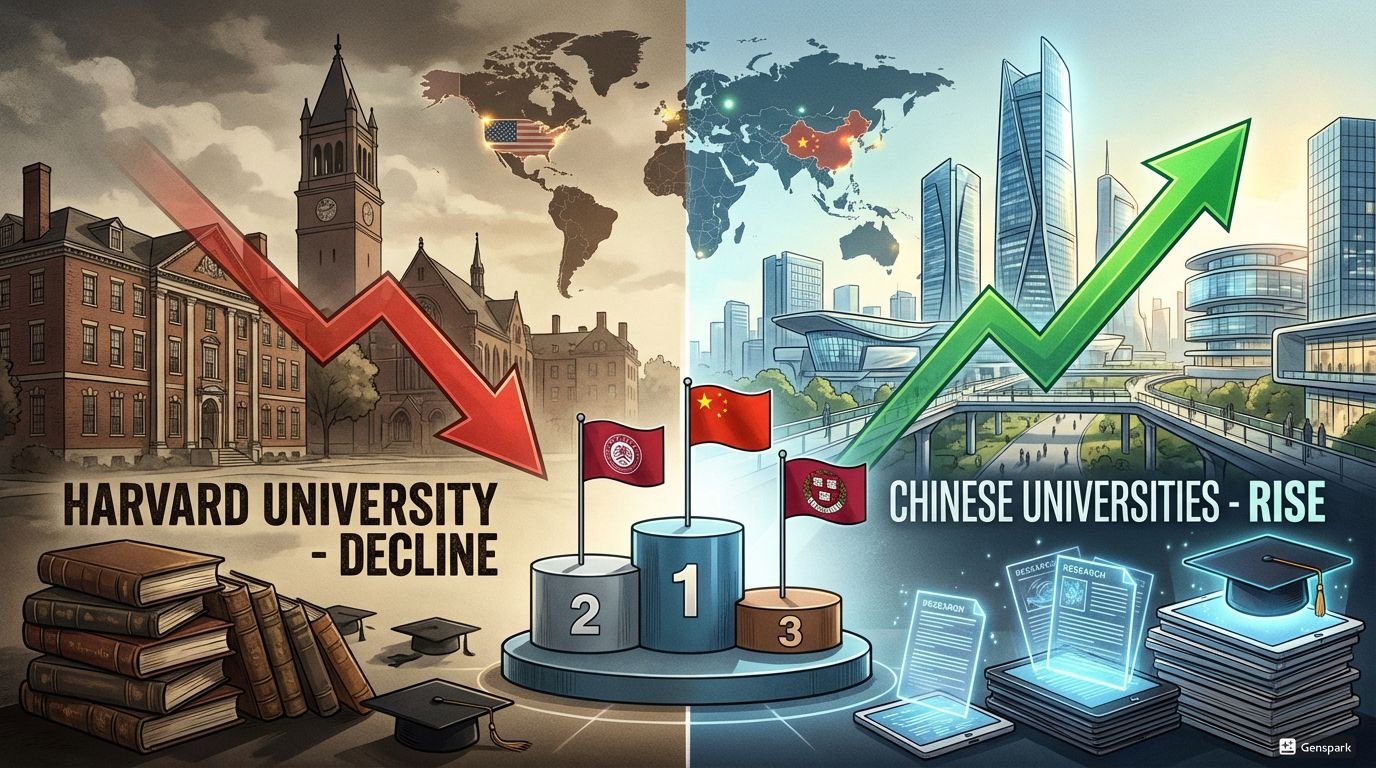
The global map of higher education is undergoing a profound and consequential shift. For decades, the United States and the United Kingdom dominated the world’s university system, setting standards in research, innovation, and academic influence. Today, however, that long-standing monopoly is being decisively challenged ; and in some key measures overtaken by Chinese universities.
A compelling account of this transformation was presented in The New York Times on January 15, 2026, which reported that Chinese institutions now lead the world in research output, a metric long associated with American academic supremacy. The findings, drawn from internationally recognised ranking systems, underscore a strategic and sustained rise rather than a temporary fluctuation.
The Ranking That Changed the Narrative At the centre of this shift is the CWTS Leiden Ranking, produced by the Centre for Science and Technology Studies at Leiden University in the Netherlands. Unlike reputation-based rankings, Leiden focuses strictly on scientific publications and citations, making it one of the most objective measures of research productivity.
According to the latest data cited by the New York Times, Zhejiang University and Shanghai Jiao Tong University now rank above Harvard University, pushing the world’s most iconic institution to third place in research output. Even more striking is the broader picture: Chinese universities occupy the majority of the top ten positions, a space once dominated almost entirely by American and British institutions.
This development is historically significant. It marks the first time that Western universities; particularly those in the United States — have lost clear leadership in the core domain of academic research production.
Beyond One Ranking: A Systemic Rise The Leiden data is not an outlier. Other global assessments reinforce the same conclusion. The Center for World University Rankings (CWUR) reported in 2025 that China now has more universities ranked among the world’s top 2,000 than the United States, a milestone that would have seemed improbable even a decade ago.
Meanwhile, rankings such as Times Higher Education (THE) and QS World University Rankings, which incorporate teaching quality and global reputation, show steady upward movement by Chinese institutions such as Tsinghua University and Peking University. While Oxford, Cambridge, MIT, and Stanford remain prestigious, their dominance is increasingly shared rather than absolute.
Why China Is Advancing China’s rise is neither accidental nor organic. It is the outcome of deliberate, long-term state policy. Massive public investment in universities, aggressive funding for research laboratories, incentives for international publication, and close collaboration between academia and industry have transformed Chinese universities into global research engines.
Equally important is scale. China produces tens of thousands of PhDs annually in science, technology, engineering, and medicine, feeding a research ecosystem that now rivals — and in volume surpasses — that of the United States and the United Kingdom. Western Slowdown, Not Collapse
It would be misleading to interpret this shift as the decline of Western education. American and British universities remain leaders in innovation, liberal arts, and academic freedom. However, the New York Times report rightly notes that reduced public funding, restrictive immigration policies, and growing political pressures have slowed research momentum in the United States.
In a world where knowledge production increasingly defines economic and geopolitical power, even a relative slowdown has global consequences.
Implications for the Global South and Pakistan For Pakistan and other developing nations, China’s academic ascent offers important lessons. It demonstrates that global academic leadership is not culturally fixed, but policy-driven. Sustained investment, institutional autonomy, and international engagement can reposition national universities within a generation.
Pakistan’s higher education system, while expanding, remains under-resourced and under-integrated into global research networks. The Chinese experience highlights what is possible when education is treated as a strategic national priority rather than a residual budget item.
A New Academic Order The evidence is clear. China has emerged as a leading force in global university education and research, narrowing, and in some areas surpassing the long-standing lead of the United States and the United Kingdom. This does not signal the end of Western excellence, but it does mark the end of Western exclusivity. The world is entering a multipolar academic era, and China is no longer catching up; it is setting the pace.
Federal Minister for Climate Change and Environmental Coordination, Dr. Musadik Malik, addressed the launch ceremony of the Climate Finance Accelerator (CFA) in Islamabad, describing the initiative as a timely platform to mobilise climate finance for projects and enterprises aligned with Pakistan’s national climate priorities.
The Climate Finance Accelerator is a UK Government–funded technical assistance programme designed to help countries unlock investment for climate-resilient and low-carbon development by supporting viable projects and businesses in accessing international finance.
Speaking at the event, Dr. Malik stressed the pivotal role of youth in Pakistan’s climate and economic transformation. “We are a developing economy, and there is an urgent need to empower our youth. If we provide access and opportunities to young people, they can bring about a revolution for this country and for our economy,” he said.
Citing global examples, the Minister noted that cities such as Beijing and Shanghai were among the most polluted in the world just a decade ago, yet China now exports nearly 70 percent of global solar technology. “What did Chinese youth have that Pakistani youth lack? It was not talent or ability, it was opportunity,” he remarked. He also referred to Finland and other Nordic countries for their pioneering measures in forest protection and environmental sustainability, suggesting that Pakistan could draw valuable lessons from their experiences.
Dr. Malik underscored that initiatives like the CFA can create pathways for young entrepreneurs and innovators to turn climate-focused ideas into investable ventures. He highlighted the Ministry’s Green Fields Programme as a complementary platform where young innovators can present climate solutions and connect with investors. “Under Green Fields, the Ministry will link young entrepreneurs with national and international investors. We have already facilitated two Pakistani companies to pitch their ideas to international investors in Seville, Spain,” he shared.
Appreciating development partners, the Minister acknowledged the support of DAI for providing both technical and financial assistance. “We are going to work with our young people shoulder to shoulder. I want to transform this Ministry into an accelerator for youth—an incubation centre where ideas are nurtured and scaled,” he concluded. – ER News Desk
Syed Moonis Abdullah Alvi has resigned as Chief Executive Officer of K-Electric, media reports said. He was facing a situation linked to harassment allegations raised by a former employee of the company.
Alvi submitted his resignation to the Chairman of K-Electric and departed for Umrah, a report said on Friday.
On Feb 3, K-Electric had informed the KSX that the Governor of Sindh has set aside the order previously issued by the Provincial Ombudsman, Sindh, against the company’s Chief Executive Officer in a harassment complaint case.
The development follows K-Electric’s earlier disclosure dated August 1, 2025, regarding an order passed by the Provincial Ombudsman on July 31, 2025, in a complaint filed by a former employee under the Protection against Harassment of Women at the Workplace Act, 2010. The complaint had been lodged against two employees and a former director of K-Electric, said the company’s notice to the Pakistan Stock Exchange.
According to K-Electric, the Governor of Sindh, exercising powers under Section 9 of the Act, heard the parties and reviewed the relevant record before issuing the decision to set aside the Ombudsman’s July 31, 2025 order.
Alvi joined K-Electric in 2008 and held several key positions during his tenure, including Chief Financial Officer, Company Secretary, and Head of Treasury. In 2018, he was appointed as the CEO. With over 30 years of professional experience, Alvi led multiple initiatives at the utility, including the globally recognized “Roshni Baji” program, and was widely regarded as the public face of the company in the media.
Last year, former K-Electric Chief Marketing and Communication Officer Meherin Aziz Khan accused Alvi of harassment, intimidation, and causing mental distress. She filed a complaint with the Provincial Ombudsman Sindh, Justice (Retd.) Shah Nawaz Tariq. The Ombudsman had ordered Alvi’s removal from office and imposed a fine of Rs 2.5 million.
Alvi consistently denied the allegations and announced his intention to challenge the Ombudsman’s decision.
Although the Governor’s decision provided some relief to Alvi, sources say he had already decided not to continue in his role as CEO. It is further claimed that after handing over his resignation to the Chairman, Alvi left for Umrah. – ER News Desk
Karachi was once envisioned and briefly lived up to its reputation as a modern, orderly, and cosmopolitan city. Before the 1960s, it functioned as a planned urban center with strong municipal governance, functional infrastructure, and a visible sense of civic responsibility. This transformation was not accidental; it was the result of visionary leadership, organized civic institutions, and communities that believed in building and protecting public assets. Wide roads, efficient public services, disciplined neighborhoods, and respect for public space defined the city’s character. Today, despite massive investments in infrastructure, Karachi stands far removed from that vision.
A key architect of Karachi’s early modernization was Seth Harchandrai Vishandas (1862–1928), widely recognized as the Father of Modern Karachi. Serving as mayor from 1911 to 1921, he transformed Karachi from a modest town into a functioning modern city. Under his leadership, electricity was introduced in 1913, gas lamps illuminated the streets, footpaths were laid, and major arteries, such as Bunder Road, were upgraded. As a central figure in the Karachi Municipal Committee, Harchandrai Vishandas studied international city laws and implemented cleaner, more organized systems of civic planning; principles that today’s Karachi sorely lacks.
Alongside him, the Parsi community played an indispensable role in the city’s civic and infrastructural development. Their contributions to municipal services, urban discipline, philanthropy, and institutional governance helped Karachi emerge as one of the best-managed cities in the region. Jamshed Nusserwanji Mehta, Karachi’s first elected mayor (1933–1940), is remembered as the visionary civic leader who laid the foundations of the city’s modern, inclusive municipal governance.
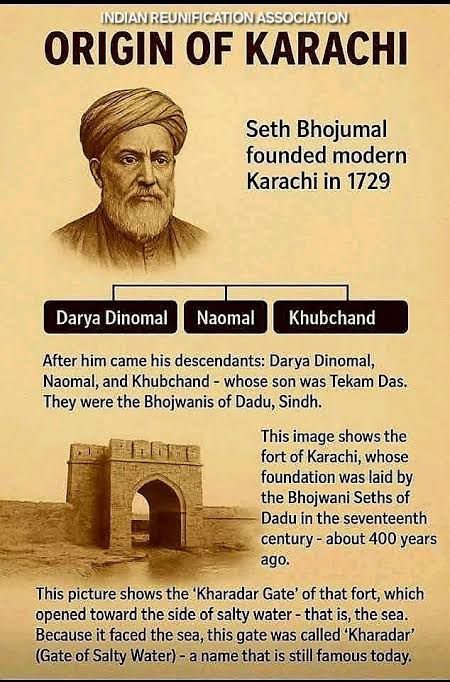
Seth Bhojumal, another early pioneer, was instrumental in the city’s foundational growth, while developers such as Hussain-D’Silva Construction Company contributed to early modern infrastructure, including the construction of the first government barracks in 1946.
Historically, Sindhi Hindus were central to establishing and building Karachi. Their legacy remains visible today in old historic buildings, temples, commercial districts, and early infrastructure that once symbolized stability, planning, and civic pride. The modernization of Karachi before the 1960s was therefore a collective achievement rooted in leadership, community participation, and respect for urban systems.
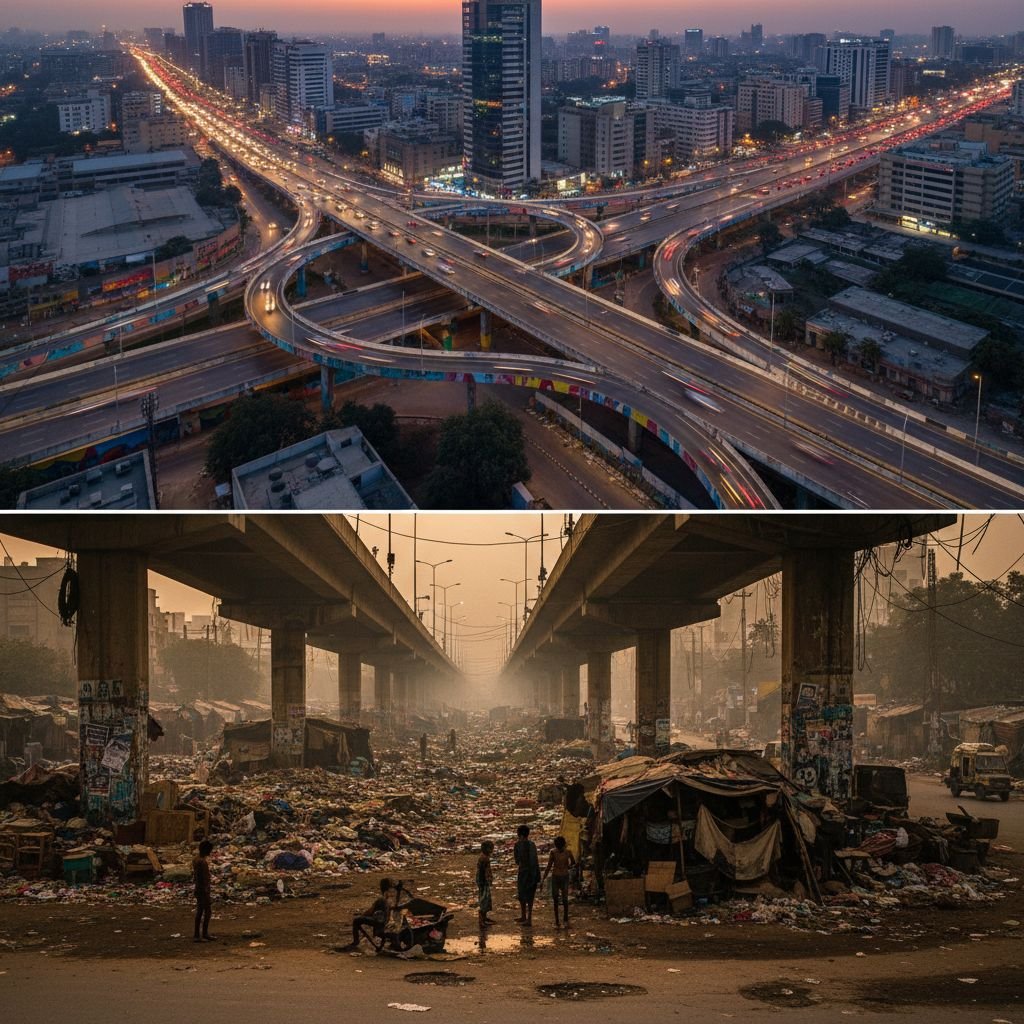
In stark contrast, present-day Karachi offers a different picture. From aerial footage, the city appears impressive. Hundreds of flyovers, underpasses, and multilane roads glitter with decorative lights, fresh paint, and artistic murals. At night, Karachi can look aesthetically pleasing, almost futuristic. Yet this beauty is largely cosmetic.
At ground level, the illusion collapses. Beneath nearly every flyover lies neglect. These structures, built at enormous public cost, have become shelters for drug addicts and informal encampments, while the loops and edges of bridges are routinely used as open garbage dumps. Roads meant to symbolize mobility and progress have turned into channels where waste is casually thrown from high-rise buildings. Public infrastructure exists, but public responsibility does not.
Streetlights are installed without protection or maintenance. Their wiring is stolen, bulbs disappear, and only hollow poles remain mute witnesses to institutional failure. Artistically painted walls, intended to promote culture and civic pride, are quickly defaced with pan stains and litter. This decay is not merely social indiscipline; it reflects the collapse of enforcement, ownership, and urban ethics.
The problem is magnified by the absence of maintenance planning. Billions of rupees are spent on construction, yet almost nothing is allocated for upkeep. Infrastructure is treated as a political showcase rather than a living system. Roads break, drains clog, lights fail and no institution is clearly accountable. Development without maintenance is not progress; it is structured waste.
Equally alarming is Karachi’s failure to implement a comprehensive solid waste management system. In many countries, waste is treated as an economic resource through recycling, energy generation, and organized collection. Karachi, despite its scale, continues to rely on informal and hazardous practices. At a disturbing level, children, often from marginalized Pashtun communities, can be seen collecting recyclable materials from garbage dumps to survive. This is not urban resilience; it is urban abandonment.
Karachi also lacks strong, empowered city institutions comparable to those governing cities such as Singapore or New York. A modern city requires autonomous municipal authority, professional urban planners, transparent revenue systems, and strict enforcement of civic laws. Karachi’s governance remains fragmented across multiple agencies and political interests, rendering it incapable of managing a megacity.
A further structural injustice lies in Karachi’s relationship with the federation. The city generates a substantial portion of Pakistan’s revenue while accommodating millions from across the country. Despite this, it receives disproportionately limited resources for sanitation, housing, transport, and social services. A city that sustains the national economy cannot be allowed to decay under fiscal neglect.
Reviving Karachi as a modern city requires more than flyovers and decorative paint. It demands a return to the principles that once defined it under leaders like Seth Harchandrai Vishandas, Jamshed N Mehta, strong municipal governance, informed civic planning, respect for public assets, and community ownership. Citizens must be educated to protect public spaces, while the state must enforce laws impartially. Maintenance must become as important as construction, and waste must be managed as an economic and environmental priority.
Karachi does not lack history, capacity, or potential. It lacks vision, discipline, and continuity. If the city is to reclaim the spirit it possessed before the 1960s, development must move beyond cosmetic infrastructure toward human-centered urban management. Only then can Karachi transform from a city that looks modern from the sky into one that truly lives and functions as a modern city on the ground.
Federal Minister for Planning, Development and Special Initiatives Ahsan Iqbal has announced a five-year program under which 10,000 engineers will be trained annually on PSDP project sites for a year, with a monthly stipend of Rs50,000. The initiative, part of the government’s youth-focused program, aims to benefit 50,000 engineers in total, with funding drawn from development program contingencies.
The minister has compared the initiative to the house job system for doctors, arguing that it will improve employability, reduce unemployment, and discourage outward migration. While the announcement signals recognition of the engineering employment crisis, experts argue that training without economic restructuring risks becoming symbolic rather than transformational.
Pakistan’s Economic Context: Why Numbers Matter Any serious assessment of this program must begin with Pakistan’s economic fundamentals, because engineering demand is not driven by population size alone but by industrial depth and GDP composition.
Pakistan is the world’s fifth most populous country, yet remains under-industrialized. Manufacturing contributes only around 13 percent of GDP, while growth is largely driven by consumption, remittances, agriculture, and real estate, sectors that generate limited demand for engineers.
Pakistan at a glance
Indicator
Pakistan
Population
240 million
GDP (nominal)
$US 340–360 billion
Average GDP growth
3–4 percent
Manufacturing share of GDP
13 percent
Engineering exports
Negligible
This context explains why engineering unemployment persists despite a steady output of graduates.
Engineering Density: How Pakistan Compares Regionally
One commonly used global benchmark is engineers per 10,000 population, which reflects how deeply engineering is embedded in an economy. Countries with strong manufacturing, technology, and export sectors consistently show higher engineering density.
Pakistan’s ratio remains significantly lower than its regional peers—not because it produces fewer graduates, but because industry does not absorb them.
Engineers per 10,000 population:This gap reflects differences in economic structure, not education systems.
Country
Engineers / 10,000
Malaysia
45–50
India
25–30
Pakistan
8–10
This gap reflects differences in economic structure, not education systems.
Pakistan, India, and Malaysia: Similar Size, Very Different Outcomes
A comparison with India and Malaysia further highlights the structural issue. Malaysia’s economy is only modestly larger than Pakistan’s in nominal terms, yet it sustains a far higher number of engineers due to export-led industrialization and technology-intensive growth.
Macro comparison:
Indicator
Pakistan
India
Malaysia
Population
240m
1.43bn
34m
GDP (nominal)
$US 350bn
$US 3.7tn
$US 440bn
Manufacturing (percent of GDP)
13 percent
17–18 percent
23–25 percent
Engineering exports
Negligible
$US 100bn+
$US 40bn+
Engineers per 10,000
8–10
25–30
45–50
The lesson is clear: engineering employment follows industrialization, not training programs alone.
GDP Growth Quality: Why Engineers Remain Underutilized Experts stress that not all GDP growth creates engineering jobs. Growth driven by agriculture, consumption, or remittances produces limited technical demand, whereas growth driven by manufacturing, infrastructure, energy, and technology is engineering-intensive. This distinction explains why Pakistan experiences periods of GDP growth without corresponding improvements in engineering employment.
The Engineer–GDP Demand Relationship Planners often use an Engineering Intensity Factor (EIF) to estimate how many engineers an economy can realistically absorb per $US 1 billion of GDP.
Engineering Intensity Factor benchmarks:
Economy Type
Engineers per $US 1 bn GDP
Low-industrial
700–900
Mid-industrial
1,200–1,500
Export-led / high-tech
1,600–2,000
Applying this framework to Pakistan
GDP $US 350 billion Current EIF 700 Estimated demand 245,000 engineers
This figure closely matches the number of engineers currently absorbed in core sectors, explaining why additional graduates face underemployment.
Sectoral Distribution: Where Engineers Actually Work
Another revealing comparison is how engineers are distributed across sectors. In Pakistan, most engineers are confined to execution-heavy construction roles, while design, automation, R&D, and technology remain underdeveloped.
Share of engineers by sector:
Sector
Pakistan
India
Malaysia
Manufacturing
25 Percent
40 Percent
45 Percent
Construction & infrastructure
35 Percent
25 Percent
20 Percent
Energy & utilities
15 Percent
15 Percent
15 Percent
Technology & automation
5 Percent
15 Percent
20 Percent
R&D & design
<2 Percent
10 Percent
1 Percent
This imbalance limits productivity, innovation, and export potential.
Why the “House Job” Analogy Is Problematic Experts argue that equating the proposed program with doctors’ house jobs overlooks key differences: – Medical house jobs operate within a regulated national healthcare system – Engineering projects are contractor-driven, often lump-sum, cost-focused, and short-term – Engineering competence develops through long-term industrial engagement, not brief site exposure – Without permanent roles, six-month/one year placements risk becoming stopgap measures rather than career pathways.
Persistent Concerns Raised by the Engineering Community Key concerns include: – Political motivation and past failures of similar program – Lack of transparency and merit-based selection – Temporary nature with no guaranteed absorption – Absence of credible national data on engineering unemployment – Ignoring private-sector contracting practices – Global mobility of engineers cannot be restricted – Rapid disruption from AI and emerging technologies – Weak linkage between economic growth and engineering demand
The Core Issue Remains Economic Structure The central conclusion emerging from expert analysis is unequivocal: Pakistan does not have too many engineers—it has too little engineering-driven growth. Until manufacturing rises toward 20 Percent of GDP, engineering exports expand meaningfully, and growth becomes industry-and technology-led, training initiatives alone will not resolve unemployment.
Necessary, But Not Sufficient
The government’s training program may offer short-term exposure and financial relief, but without structural economic reform, it risks joining a long list of well-intentioned but ineffective interventions.
As global experience shows, skills follow growth, not the other way around. For Pakistan’s engineers, sustainable employment will come not from temporary placements, but from an economy that finally begins to grow through engineering itself.
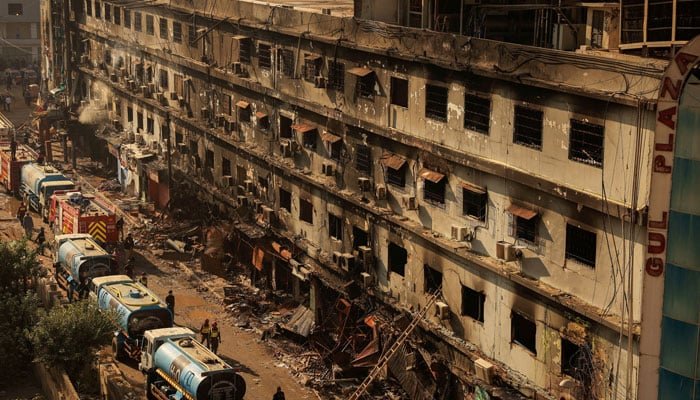
The fire operation at Gul Plaza in Karachi’s South District has been declared complete, with official figures confirming that 79 people lost their lives, either due to burns or suffocation. Yet another deadly incident has added to the long list of urban tragedies in Pakistan’s largest city—one marked by poor governance, weak regulatory enforcement, and chronic neglect of safety standards.
While the forensic report is still awaited, unofficial accounts circulating suggest that the fire may have been triggered by children playing with burnt matchsticks inside the building. Authorities, however, have not yet confirmed the cause of ignition. What is beyond dispute, according to fire safety and engineering experts, is that the scale of damage and loss of life could have been drastically reduced—or entirely prevented—had basic fire safety measures been implemented and followed.
A Building Without Safety Gul Plaza is one among thousands of buildings in Karachi that fail to meet even the minimum fire safety requirements. Experts point out that both commercial and residential occupants often remain indifferent to emergency preparedness, evacuation planning, and fire prevention—until disaster strikes. “This incident has once again exposed the real state of our governance and regulatory systems,” said one expert, noting that similar questions have arisen after every major fire tragedy in Karachi over the past 15 years: Why do so many people die in relatively small buildings?
Codes Exist, Compliance Does Not Pakistan is not short of laws or technical guidance. The Pakistan Engineering Council (PEC) developed a comprehensive Building Code of Pakistan several years ago, which clearly outlines requirements for emergency exits, fire-resistant design, evacuation routes, and firefighting systems. The code applies across the federation. In Sindh, additional provisions exist under the Occupational Safety and Health Act, which also incorporates building safety standards. However, experts say the problem lies in implementation and enforcement, not legislation. Design engineers, they argue, must also ensure that approved drawings strictly follow these codes and that building control authorities enforce compliance without exception.
The First Three Minutes Matter Fire safety specialists emphasize that the first three minutes of a fire are critical. If a fire is controlled during this window, a major catastrophe can often be avoided. “There is a severe lack of awareness among the general public,” said Jawed Akhtar, a fire safety expert. “In Gul Plaza, we saw panic, lack of coordination, no understanding of how to operate firefighting equipment, and no emergency response plan. Smoke disorients people—without training, they don’t know where to go.” According to him, a functional emergency response plan alone could have saved every life. “There should have been immediate announcements, organized evacuation, and trained personnel guiding occupants towards emergency exits.”
Awareness, Training, and Attitude Change Ali Ashraf, another expert, stressed that engineering solutions already exist, but they are useless without awareness and training. “Even if firefighting equipment is installed, it cannot be used effectively unless people are trained,” he said. “Residents and workers in multi-storey buildings must understand fire types, extinguisher usage, and evacuation protocols. Missing the initial three minutes often means losing control entirely.” He added that people must also understand the five classes of fire and the fire triangle—oxygen, fuel, and heat—to respond appropriately.
Start Early, Educate Deeply Aijaz ul Haq, Secretary, the Institution of Engineers Pakistan, Karachi emphasized the need for long-term sensitization, suggesting that fire safety concepts should be included in school curricula. “If people learn about fire behavior, risks, and response from childhood, they become safer adults,” he said. “We already have laws and regulations. Building associations should deploy trained volunteers at entry and exit points to guide occupants during emergencies.”
Role of Engineering Bodies and Media Engr. Ayaz Mirza, the organizer of OHSE Conference of the Institution of Engineers Pakistan highlighted the role of professional institutions such as the Institution of Engineers Pakistan (IEP), which regularly submits safety recommendations to government departments and conducts awareness activities. “Not all recommendations are implemented, but some have been incorporated into law,” he said, adding that pressure on authorities has continued for over a decade. Experts unanimously stressed that the media must play a proactive role in spreading fire safety awareness. Collaboration between engineering bodies and media platforms could significantly improve public preparedness.
Survey of Unsafe Buildings Urgently Needed Experts called on the Pakistan Engineering Council, in collaboration with builders’ associations such as ABAD, to conduct an urgent survey of buildings in old and semi-old areas of Karachi. They also pointed out that, according to existing laws, there should be at least one fire station for every 100,000 people—a requirement that is far from being met in many parts of the city.
A Preventable Loss The Gul Plaza fire is not an isolated incident but a systemic failure of planning, enforcement, awareness, and accountability. Experts agree that unless building safety codes are enforced, emergency preparedness is institutionalized, and public awareness is taken seriously, such tragedies will continue to repeat themselves. And each time, the question will remain the same: Why were lives lost when the solutions were already known?
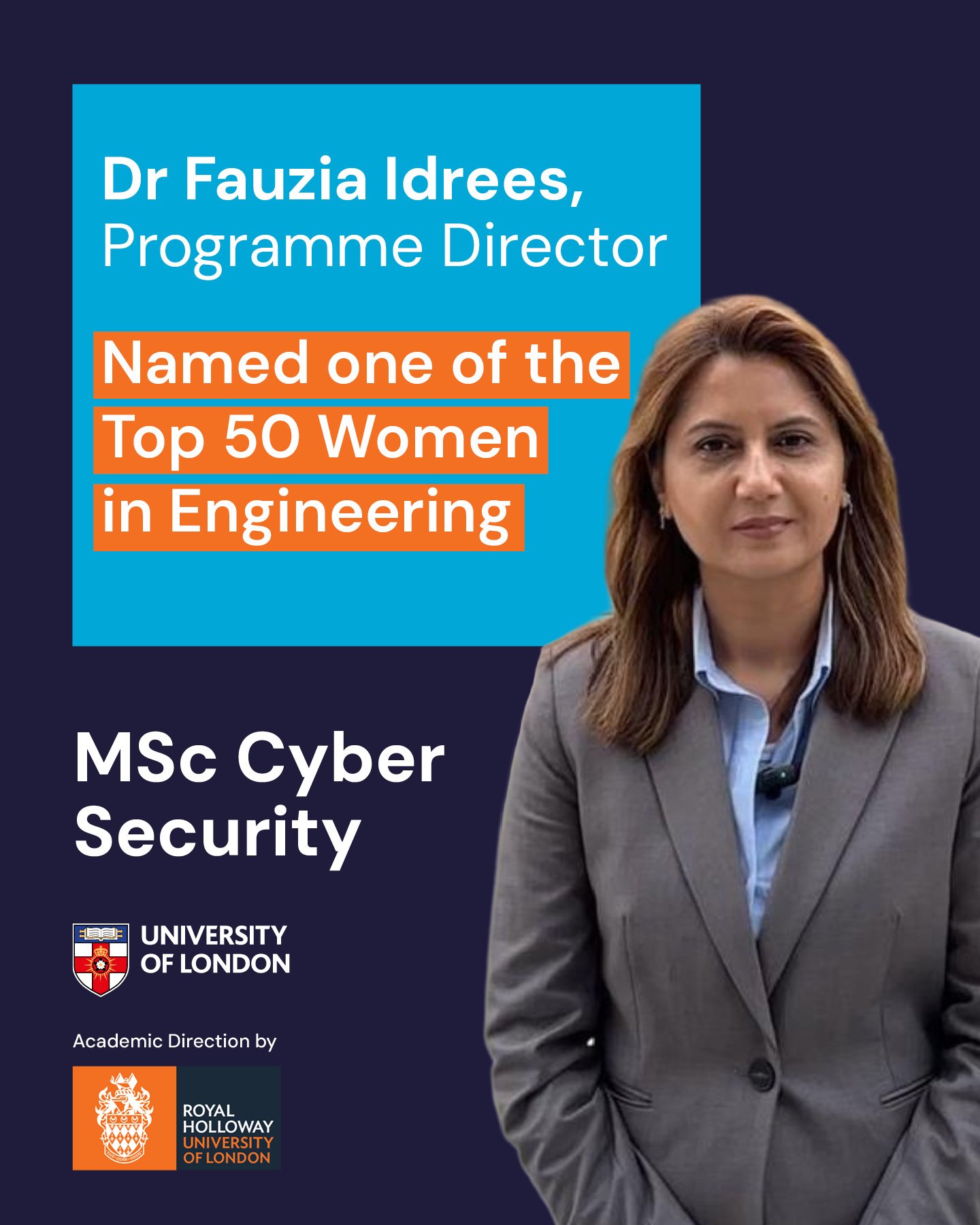
Dr Fauzia Idrees, Programme Director of the MSc Cyber Security programme, has been recognized among the Top 50 Women in Engineering 2025 by the prestigious Women’s Engineering Society (WES)—a global platform that celebrates the achievements of women making significant contributions across engineering disciplines.
The recognition highlights Dr Idrees’ outstanding work in advancing cyber security education, promoting diversity in technology, and preparing the next generation of professionals to tackle evolving digital threats in an increasingly connected world.
Speaking about the philosophy behind the programme, Dr Idrees remarked, “Cyber security is not just about technology, it’s about people, trust, and protection—and that means it thrives on diversity of thought, background, and experience. Whether you’re interested in the technical aspects, policy, education, or the human and behavioural sides of security, there’s a place for you.”
Her vision underscores a holistic approach to cyber security that goes beyond coding and networks to include ethics, human behavior, governance, and trust—areas that are becoming central to modern digital protection strategies.
Under her leadership, the MSc Cyber Security programme has evolved into a multidisciplinary platform that combines technical excellence with real-world applicability. The curriculum emphasizes practical learning, research-driven insight, and industry alignment, equipping students with skills in digital forensics, threat intelligence, risk management, cyber law, and secure system design.
Dr Idrees’ inclusion in the WES Top 50 list not only celebrates her personal achievement but also signals the growing global recognition of the role educators play in shaping resilient digital ecosystems. Her work continues to inspire students—especially women—to pursue careers in engineering and cyber security, fields where gender representation has historically been limited.
Profile: Dr Fauzia Idrees
Dr Fauzia Idrees is an accomplished academic and cyber security specialist serving as the Programme Director of the MSc Cyber Security programme. With a strong background in information security, digital risk management, and cyber policy, she has been instrumental in developing an education model that blends technical depth with human-centered understanding of security.
She is a strong advocate for diversity in engineering and believes that inclusive perspectives are critical to building safer digital systems. Her teaching and research interests span cyber governance, behavioral aspects of security, digital ethics, and emerging threats in cyberspace.
Through her leadership, mentorship, and curriculum development, Dr Idrees has helped create pathways for students from varied backgrounds to enter and excel in the cyber security domain. Her recognition by the Women’s Engineering Society places her among an international community of women engineers driving change, innovation, and inclusivity across the engineering spectrum. – ER News Desk