Chairman Pakistan Engineering Council (PEC) Engr. Najeeb Haroon has said that to improve the country’s economy, work on reverse engineering needs to be done, adding that “we have let our engineers down”. While energy remains a priority, IT and agriculture should be given due importance to improve the economy of Pakistan.
He was addressing as the Chief Guest at the IEEEP Multitopic Symposium 2023 held in Karachi with the presence of a large number of engineers and professionals from all over the country.
Earlier Engr. Khalid Pervez, leading the organization’s Karachi chapter highlighted the need of promoting a ‘Made in Pakistan’ approach.
Engr. Najeeb Haroon said that in small items we import even staplers. In large-scale industries, local value addition needs to be drastically improved.
The western world needs engineers, and perhaps we can earn foreign exchange by body leasing while we create jobs for our engineers in the Country.
We will have to think seriously in this direction,” he said adding that PEC engineers were supposed to work as “a brain” of the country. Unfortunately, the brain is not being used therefore nothing is coordinated.
Instead of its engineering experts, other unconcerned people are in the decision-making positions in every department, due to which no department is working properly.
The PEC Chairman asserted that for some reason the bureaucracy despises the engineering community and has no respect for the best-educated people in the country. This is the reason why good-performing college students are losing interest and admissions to engineering universities are falling. This trend needs to be changed.
He agreed with Engr. Khalid Pervez that “Make in Pakistan” should be part of our policies. Locally manufactured goods should be preferred. For the development of Pakistan, it is necessary to use the services of local experts.
A senior member of IEEEP, Engr. Irfan Ahmad who was the Chief Guest of the closing session being the recipient of this year’s IEEEP Life Time Achievement Award said that while the Country needs its brain, it is being drained out to the West. Only last year, hundreds of Pakistani engineers left for greener pastures as we are only producing job seekers in our universities. We do not even see what is inside the box itself. The doors of the West are now closing down for the outsiders. Only last month Amazon fired 18,000 of its workers and Google fired 12,000 people, including 450 Indian engineers. India was however quick to find jobs for its engineers in other countries. Our government on the other hand has not yet been able to provide an even service structure for engineers.
In the Symposium,18 technical papers on power, energy, telecom, and electronics were presented in various sessions, which also included a Panel Discussion on local manufacturing issues.
Tag: engineeringreview
-

Reverse engineering, local experts must for prosperity: Engr. Najeeb Haroon
IEEEP confers Life Time Achievement Award on Engr. Irfan Ahmed -

Leading exploration, production companies move to green energy
Six Pakistani oil, and gas companies sign MoU for joint ventures; 15% of global energy-related greenhouse gas emissions come from oil and gas exploration
Leading oil and gas exploration companies in Pakistan have joined hands to
explore and pursue green hydrogen prospects, says the Petroleum Division of Pakistan’s Ministry of Energy.
These exploration and production companies include Oil & Gas Development Company Limited, Pak-Arab Refinery Limited, Pakistan Petroleum Limited, Mari Petroleum Company Limited, and Government Holdings (Private) Limited.
It merits mentioning that oil and gas are often painted as the dirtiest sector within the energy industry, but major companies around the world have begun to invest in renewable technologies in a bid to clean up the economy.
Of the six “super-majors” – BP, Shell, Chevron, Total, Eni, and Exxon – many of them have pumped billions into clean energy projects, although question marks remain over whether they are doing enough.
Despite the growth in renewables, “big oil” only spent 1% of its combined budget on green energy schemes in 2018.
The Petroleum Division says these companies in Pakistan have signed a memorandum of understanding (MoU) for joint ventures in the future.
The MoU will be initially effective for two years from the date of signing and it will engage consultants and advisors to explore the opportunities.
Under the MoU, the companies will also establish a joint fund to raise equity for joint ventures and green energy initiatives, said the statement.
Additional Secretary of the Petroleum Division Muhammad Mahmood, who witnessed the event, said that the collaboration could drive the energy transition towards a more sustainable future, leveraging each company’s expertise and resources.
“This collaboration is a significant step towards building a more sustainable future for Pakistan and beyond,” added the official.
On the occasion, Managing Director of the Oil & Gas Development Company Limited Ahmed Hayat Lak said, “we are confident that by leveraging our collective expertise and resources, we can accelerate the energy transition and create a greener, cleaner, and more prosperous future.”
The IEA’s Oil and Gas Industry in Energy Transitions report says while some oil and gas companies have taken steps to support efforts to combat climate change, the industry as a whole could play a much more significant role through its engineering capabilities, financial resources, and project-management expertise.
“No energy company will be unaffected by clean energy transitions,” said Dr. Fatih Birol. “Every part of the industry needs to consider how to respond. Doing nothing is simply not an option.”
The landscape of the oil and gas industry is diverse, meaning there is no single strategic response but a variety of approaches depending on each company’s circumstances.
“The first immediate task for all parts of the industry is reducing the environmental footprint of their own operations,” Dr. Birol said. “As of today, around 15% of global energy-related greenhouse gas emissions come from the process of getting oil and gas out of the ground and to consumers. A large part of these emissions can be brought down relatively quickly and easily.”
Reducing methane leaks into the atmosphere is the single most important and cost-effective way for the industry to bring down these emissions. But there are ample other opportunities to lower the emissions intensity of delivered oil and gas by eliminating routine flaring and integrating renewables and low-carbon electricity into new upstream and LNG developments.
“Also, with their extensive know-how and deep pockets, oil and gas companies can play a crucial role in accelerating deployment of key renewable options such as offshore wind, while also enabling some key capital-intensive clean energy technologies – such as carbon capture, utilisation, storage, and hydrogen – to reach maturity,” Dr. Birol added. “Without the industry’s input, these technologies may simply not achieve the scale needed for them to move the dial on emissions.”
Some oil and gas companies are diversifying their energy operations to include renewables and other low-carbon technologies. However, average investment by oil and gas companies in non-core areas has so far been limited to around 1% of total capital spending, with the largest outlays going to solar PV and wind. Some oil and gas companies have also diversified by acquiring existing non-core businesses – for example in electricity distribution, electric-vehicle charging, and batteries – while stepping up research and development activity. But overall, there are few signs of the large-scale change in capital allocation needed to put the world on a more sustainable path.
An essential task is to step up investment in fuels – such as hydrogen, biomethane, and advanced biofuels – that can deliver the energy system benefits of oil and gas without net carbon emissions. Within 10 years, these low-carbon fuels would need to account for around 15% of overall investment in fuel supply if the world is to get on course to tackle climate change. In the absence of low-carbon fuels, transitions become much harder and more expensive. -
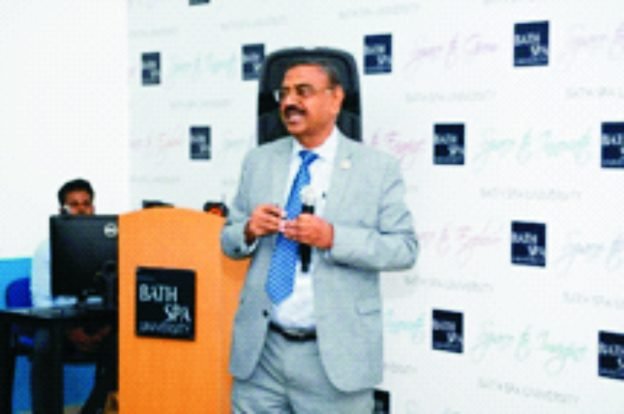
Prof BS Chowdhry’s talk at BathSpa Uni RAK Campus UAE Vertically Integrated Collaborative Projects and Experiential Learning
The 3rd International Conference on Business, Management, Emerging Technologies, and Social Sciences 2023 was held at Bath Spa University, Academic Center Ras Al-Khaimah-UAE. Sitara-e-Imtiaz Recipient Professor Dr Bhawani Shankar Chowdhry participated as a Guest of Honor and invited Keynote speaker. Prof, Dr. M N Brohi, Campus Director, Bath Spa University, Academic Centre Rak Al Khaimah, United Arab Emirates welcomed all guests and delegates.
Delegates from different countries and universities convened to showcase their work, present their latest findings, exchange ideas, and address pressing issues in their respective fields. The conference also served as a valuable platform for gaining future collaborations in the international research arena. The excellent participation and diverse range of topics covered made it a highly beneficial event for students, faculty, and researchers alike. The efforts of BSU RAK in bringing together experts from various fields to share their insights and expertise are truly commendable. The conference focused on the quality of the presentations and the level of engagement among the attendees. Observing this, it was clear that the conference provided a platform for meaningful discussions and networking opportunities.
Prof. D M Akbar Hussain, (Aalborg University, Denmark), Prof Jason Levy from University of Hawaiʻi – West oʻahu, USA, Prof Ciro Rodriguez, National University of Mayor de San Marcos and National University Federico Villarreal, Peru, Prof. Dr. Bhawani Shankar Chowdhry, Professor Emeritus Mehran University of Engineering and Technology Jamshoro Pakistan, Prof Geetha Ganesan, Professor and Dean, Jain University, India, Prof Arthur James Swart, Central University of Technology, South Africa, Dr. Kristoffer Franz Mari R. Millado, Chairman and President of the Ramon Magsaysay Memorial Colleges were among the Keynote speakers who added excellence to the conference.
Prof Chowdhry shared his views on vertically integrated collaborative projects and experiential learning. The talk was well received and the university CEO said the university is committed to achieving excellence in creativity, culture, enterprise, and innovation through research and development. BSU Connect uncovers insights and stories of diverse people at Bath Spa University Academic Center RAK. It is a celebration of Life, Stories that Resonate, and Thought-provoking Fresh Perspectives. -

Legendary Educationalist Nisar Ahmed Siddiqui Remembered
QS ImpACT Pakistan arranged an Iftar Drive session for orphan-age kids and remembered the Late Legendary Educationalist Nisar Ahmed Siddiqui, a legendary social scientist of Sindh, on his birthday at SOS Village Jamshoro on 11-04-2023. He was a great personality. He did lots of social work for local communities. This session was organized by Prem Sagar Meghwar Research Fellow, LUISS Guido Carli University, under the supervision of Prof. Dr. Bhawani Shankar Chowdhry Chair, IEEE Karachi Section Professor Emeritus / Advisor MUET/ Advisor QS ImpACT Pakistan and Engr. Muhammad Zakir Shaikh President QS ImpACT Pakistan.
Distinguished guests/speakers Prof. Dr. Fateh Muhammad Mari Vice-Chancellor Sindh Agriculture University Tandojam, Prof Dr. Bikharam Devrajani Former Vice-Chancellor Liaquat Medical University of Health Science Jamshoro Prof Dr. Muhammad Zahid Khand, Vice-Chancellor Aror University of Art, Architecture, Design and Heritage Sukkur and prof. Dr. Bhawani Shankar Chowdhry, chair of IEEE Karachi Section Professor Emeritus / Advisor MUET, talked about Nisar Ahmed Siddiqui and his social services for local communities. They also talked about various sustainable development goals to reduce poverty and climate change issues, the role of education, and empowering the education system in rural areas of Sindh. Iftar Drive and a cake cutting ceremony was arranged for kids. Students enjoyed this session and became happy and expressed their feelings by presenting their own designed congratulations Cards and flower Bouquets to cherish Prof. Dr. Bhawani Shankar Chowdhry for receiving the Presidential Civil Award Sitara-E-Imtiaz. Dr. Umair Ahmed Korai, Engr Aisha, Engr. Jatendar and Hasnain Qureshi talked to little kids and played some games. Students enjoyed this session. -

Self-Contained Embedded Designs of Microcontroller
As a self-contained system containing a CPU, memory, and peripherals, a microcontroller can be utilized as an embedded system. Most microcontrollers in use today are integrated into other pieces of equipment, including computers, smart phones, gadgets, cars, and other technology. While some embedded systems are highly advanced, many have modest memory and programme length requirements, no operating system, and simple software. Typical input and output devices include switches, relays, solenoids, LEDs, tiny or specialized liquid-crystal displays, radio frequency devices, and sensors for data like temperature, humidity, light level, etc. Embedded systems typically lack the keyboard, screen, discs, printers, and other recognizable I/O devices of a personal computer. They may also be devoid of all forms of human interaction hardware.
If field-programmable devices are used on a microcontroller, late factory changes to items that have been produced but haven’t yet shipped may be possible. Additionally, programmed memory shortens the lead time needed for the launch of a new product. It may be cost-effective to use parts that are programmed at the time of manufacture when hundreds of thousands of identical devices are needed. The programme is laid out in these “mask programmed” regions at the same time as the chip’s logic. Since it would be expensive to furnish a system with extra, expandable storage, micro-controller programmes typically have to fit in the available on-chip memory. Both assembly language and high-level code are translated using compilers and assembly lines into a little machine code that may be stored in the microcontroller’s memory. The programme memory may be easily removable read-only memory, field-alterable flash, or persistent, read-only memory that can only be programmed at the manufacturer, depending on the device.
Numerous embedded systems require the ability to read analogue signals from sensors. This is what an analog-to-digital converter is used for (ADC). Analog signals that may be supplied to a processor by a device are useless since processors are designed to understand and handle digital data, or 1s and 0s. In order to transform the incoming data into a format that the processor can understand, an analogue to digital converter is employed. A digital-to-analog converter (DAC), which is a less common function on some microcontrollers, enables the processor to produce analogue signals or voltage levels.
The architecture of microcontrollers varies greatly. In some designs, the ROM, RAM, or I/O functionalities are incorporated into the package along with one or more general-purpose CPU cores. Others have been specifically created for control applications. In order to reduce the size of control programmes, a microcontroller’s instruction set typically contains a large number of instructions for bit manipulation (bit-wise operations). To test a bit in a register and branch if the bit is set, for instance, a general-purpose processor might need several instructions, whereas a micro-controller might just need one instruction to do the same frequently needed operation. Since most microcontrollers lack a math coprocessor, floating-point arithmetic is often carried out by software. But some current architectures do have FPU and DSP optimization features. The PIC32 MIPS-based series by Microchip is one illustration.
Microcontrollers are required to respond to events in the embedded system they are managing in real-time (predictable, but not necessarily quick). An interrupt system can alert the processor to stop processing the current instruction sequence in response to certain events and start an interrupt service routine, which will handle any processing that is necessary in response to the interrupt’s source, before returning to the original instruction sequence. Interrupts can also rouse a microcontroller from a low-power sleep mode, where the processor is suspended until forced to act by a peripheral event, which is crucial here because power consumption is critical, as in battery-powered devices. -

Sir Syed University organized NIB Grand Finale Muslims are afraid of new knowledge: President Arif Alvi Chancellor SSUE&T says there are vast opportunities for creative investment in Pakistan
The President of Pakistan, Dr. Arif Alvi has said countries that want to develop and prosper focus on education and health, keeping them at top priority. Without education and health, nations cannot develop and grow. Muslims are afraid of any new knowledge.
He was speaking at the grand finale ceremony of National Idea Bank, organized by Sir Syed University of Engineering & Technology.
President Arif Alvi said that developed nations don’t depend on natural resources, as much as on intellectual resources. Nigeria has immense oil, but it is unable to convert oil wealth into intellectual wealth and prosperity. In the eyes of Hakeem, the root cause of all diseases is digestive disorder. I think our country’s digestion is also not so good. Wrong decisions made this country fall.
Federal Minister of Information Technology and Telecommunication, Syed Amin Ul Haque, said that when I took over the ministry, we had assets of 73 billion dollars, which we increased to 500 billion dollars in three years. 42 billion rupees were invested in startups. Similarly, 5 billion dollars and 75 billion dollars were invested in various projects. We introduced 29 companies. Information technology exports increased by 3 billion dollars. We provided 10,000 jobs.
Addressing the ceremony, Chancellor of Sir Syed University of Engineering & Technology (SSUET), Jawaid Anwar, said that Sir Syed University was selected as the National Host for the National Idea Bank (NIB) project on the basis of its outstanding performance and we lived up to expectations. The establishment of National Idea Bank is an important step towards the promotion of new and innovative concepts and ideas. Our youth often have the best ideas in their minds. But due to lack of resources and absence of a proper platform, their dreams remain incomplete. NIB provides them with the opportunity to make their dreams come true.
He said that due to rising inflation, poverty and lack of resources, it is hard to get employment, almost impossible. In this context, entrepreneurship will be of great help to the youth at the grassroots level in solving economic problems in the coming times. We should be aware of the fact that time is changing. Now the function of universities is not only to award degrees but to guide students towards entrepreneurship and self-employment. Starting a business requires investment of time and resources as well as new ideas and fresh thinking. The purpose of National Idea Bank is to nurture new ideas. The journey that started at the local level has now become a pyramid at the national level, ensuring the involvement of the creators from all over Pakistan.
Chancellor Jawaid Anwar said that it is a good sign that, despite the recession, there are vast opportunities for creative investment in Pakistan. The investment of venture capitalists in Pakistani start-ups has increased many times due to which it has become possible for small entrepreneurs to make their dreams come true. We have to convince our youth to follow this direction.
Vice Chancellor SSUET, Prof. Dr. Vali Uddin said that we have successfully completed the first round of the National Idea Bank and this is the last event of the second round as well. New ideas were collected from all over the country through the National Idea Bank. A panel of judges from various disciplines selected the projects for the awards on the basis of merit with the utmost transparency, keeping in mind the utility, commercial value and vision of the projects. is playing an active role, the results of which are very promising for the country and the nation. These ideas based on new and innovative thinking are playing an important role in establishing a strong and stable economy.
Chairperson ASPIRE Pakistan and Founder of NIB, Hassan Syed, said that we want to accelerate the growth of the knowledge economy in Pakistan by leading the innovation and entrepreneurial ecosystem, while connecting stakeholders and creating socioeconomic prosperity in an equitable and sustainable manner. For the second NIB competition we received around 4000 projects, among which we short listed to 300. -

Saudi Fund for Development contributes $240m to support Pakistan energy transition
The Saudi Fund for Development has signed a $240 million loan agreement to help build a major hydropower complex in Pakistan’s northwest, the Pakistani government said, adding it would contribute to the country’s energy security and increase its resilience against floods.
Cash-strapped Pakistan relies heavily on energy imports from other countries.
Islamabad has lately been looking to shift its energy sector to alternate sources, including hydro- and solar-power stations.
The country also witnessed deadliest floods last year that killed more than 1,700 people, affected 33 million others and cost $30 billion in losses.
The Mohmand Multipurpose Dam Project will enhance water and food security, and improve the standard of living for people living in the northwestern Khyber Pakhtunkhwa province, boosting the region’s socio-economic development by creating employment opportunities and reducing poverty levels.
“The Saudi Fund for Development has signed a $240 million loan agreement to support Pakistan’s Mohmand Multipurpose Dam Project, a major hydropower complex that will contribute to Pakistan’s energy security, increase sustainable water supply for agriculture and human consumption and improve resilience to floods,” the Pakistani economic affairs ministry said in a statement.
“This loan represents a strong partnership between Saudi Arabia and Pakistan in promoting sustainable development and achieving the SDGs (sustainable development goals).”
According to the statement, the project, which is co-financed by the Saudi Fund for Development, Organization of the Petroleum Exporting Countries, Islamic Development Bank, and the Kuwait Fund for Arab Economic Development, is expected to have a significant impact on Pakistan’s energy and water sectors.
“By using renewable energy sources, the project will generate 800MW of electricity production capacity, contributing to Pakistan’s energy security,” it said.
Pakistan and Saudi Arabia enjoy cordial, wide-ranging ties in diverse sectors, such as economy, trade, defense, energy and others. Throughout their history, the Kingdom has extended financial assistance to Pakistan in economically difficult times.
In January, Saudi Arabia’s Crown Prince Mohammed bin Salman directed the SFD to study fresh projects with a view to increasing investments in Pakistan to $10 billion instead of the previously envisaged amount of $1 billion. The SFD, to date, has financed around 41 development projects and programs in Pakistan, amounting to approximately $1.4 billion. -
Pakistan’s 1st QR Cable Verification Service for Commercial and Industrial Clients
Fast Cables Launches “Fast Tasdeeq Plus”FAST, a leading manufacturer of REAL Quality Cables & LED Lights, has announced the launch of its innovative cable verification service for commercial and industrial clients. Fast Tasdeeq Plus, is the 1st ever QR code-based cable verification service in Pakistan that allows corporate customers to verify the authenticity of their Fast Cables products easily and quickly. The Fast Tasdeeq Plus service will be a game changer in the electrical cable and wire industry in Pakistan as it will now provide commercial and industrial clients with the assurance and peace of mind that they are using genuine REAL QUALITY products. By offering customers a reliable way to verify the authenticity of its products, Fast Cables is setting a new benchmark for quality and customer service.
Fast Tasdeeq Plus works by allowing customers to scan the unique QR code pasted on the cable through the Fast App. The App then verifies the code and provides real-time information on the product’s authenticity. The Fast Tasdeeq Plus service is available to all industrial and commercial clients of Fast Cables. To use the service, clients simply need to download the Fast App, which is available for free on both iOS and Android platforms. Once the app is installed, clients can scan the code on the cable to verify its genuineness.
The launch of Fast Tasdeeq Plus is a significant milestone for Fast Cables, as it demonstrates the Company’s commitment to ensuring that its customers receive only genuine and REAL QUALITY products. By providing a reliable and efficient verification service, Fast Cables is taking a proactive approach to prevent the distribution of counterfeit products in the market.
Speaking about the launch of Fast Tasdeeq Plus, Mr. Kamal Mian, Managing Director of FAST, said: “We are proud to introduce this revolutionary verification service to our commercial and industrial clients. At Fast Cables, we believe in delivering only the highest quality products to our customers, and Fast Tasdeeq Plus is a testament of our commitment to that belief.”
For more information about Fast Tasdeeq Plus and Fast Cables’ other products and services, please visit the company’s website at www.fast-cables.com. — PR -
Learn, qualify, and get a job! Bridge program founders commit to candidates IT Industry Academia Bridge Program launched, will be spread over 16 universities in Sindh
The IT Industry Academia Bridge Program designed to train 3000 undergraduates in 16 public sector universities in Sindh was launched at Shaheed Benazir Bhutto University (SBBU), Lyari Karachi last week.
The ceremony held at the university’s main campus was presided over by Tanzila Umi Habiba, Special Assistant to the chief minister for Information, Science, and Technology. ‘With the execution of this program, my dream has come true, it was close to my heart from the very beginning’, she said.
We shall facilitate young people who want to lead the province in IT and other technologies, Tanzila assured. We have brought an expensive program to your university and now it is up to you how you benefit from it, she addressed the students.
The lead partner of the IS&T Department, Managing Director of Hazza Institute of Technology, Azhar Iqbal told the gathering that they had picked up the best lot of trainers from the IT industry across Pakistan. Because they wanted the successful trainees should go directly for job placements.
Almost 70 IT companies are with us, he claims assuring qualified trainees that they would be placed for jobs directly.
Vice Chancellor SBBU Dr. Amjad Siraj Memon welcomed the guests as hosts and appreciated the program, hoping the government would provide the requisite IT infrastructure to make the program a success. Dr. Memon said there was a big gap between industry and academia adding that despite the students being trained but still the probability of employability remained a question because they did not have industry exposure.
We have started paid internships at our university so that they ensure to be at their workplace as well as at the university. Now our IT Department is one of the leading departments in the university, Memon claims.
The training program which is executed in collaboration with Hazza Institute of Technology (HIT) includes IT training of the students of 6th to 8th semesters in 8 subjects that include MERN Stack, Web Engineering Basic LAMP/WAMP stack, Cloud Solution Architecture, SAQ (Selenium and Test Complete), Mobile App Development, MERN stack (Express, Mongo, and Node), Web Engineering Advance and Mobile App Development (React and Native).
Besides training students in various districts of Sindh, 200 faculty members and staff would also be trained.
Dr. Arshad Masood Director, IAB shared the overview of the program to a jam-packed university auditorium before MD Datacom Limited Syed Zulfikar Ali who talked about the IT Industry perspective.
Dr. Ashraf who has worked with academia for forty years said this is a very special initiative of the Sindh government. The result of industry-academia collaboration has been disappointing so far.
He talked about the utility of the bridge program saying the training designed under this program matched global demand. IT students learn low-scale skills in universities whereas we are talking about most modern skills.
This is like a semester course spread over 80 hours of which 20 percent would be utilized on theory and 80 percent on practical. Altogether, there will be 16 sessions spread over 18-week activity. The course would be embedded with regular semester programs of the universities.
He said they had selected the most experienced trainers from the industry as it was an industry-oriented program and not based on knowledge only.
Asif Ikram, the Secretary IS&T Department shared the Digital vision of Sindh saying over 60 percent population of the country is comprised of young people. We are investing in human capital which cannot be done without young people being trained.
The gathering was attended by IT professionals from the private sector and faculty members of the university besides government officers. -

Is Sindh serious to takeover power sector?
The Sindh government finally moved towards establishing the Sindh Electric Power Regulatory Authority (SEPRA) to take over the power sector in the province after its cabinet approved the birth of the entity last week.
As per the National Electric Power Regulatory Authority (NEPRA) Act 1997, the provinces are allowed to construct power houses and grid stations and lay transmission lines for use within the province, and determine the tariff for distributing electricity within the province.
The step is widely welcomed nonetheless, with a caution that the Sindh government ought to take complete responsibility and demonstrate a level of governance, otherwise the authority is doomed to add more problems.
Also, the move is understood to have a background as the provincial government had found itself in a narrow street in the backdrop of its renewable power projects, and of them, almost all had been stuck up and failed to find a place in the center’s indicative generation capacity plan.
Sindh Energy Minister Imtiaz Ahmed Shaikh has been expressing his anguish about Sindh’s renewable power projects being kept at bay in Islamabad. Last year, the provincial government had made up its mind about setting up SEPRA, which finally got node last week.
But the question is: would the establishment of SEPRA minimize the woes of Sindh? The government says it is aimed at improving energy quality and eliminating energy poverty in the province. Syed Murad Ali Shah, the chief minister, believes the decision is a historic step toward power generation, transmission, and distribution.
Energy Minister Imtiaz Ahmed Shaikh reportedly told the meeting that Sindh is blessed with an entire value chain of energy resources, like coal, solar, and wind energy among other things, with cost-effective access through air, land, and sea routes.
Shaikh said that these resources can be used to generate electricity wheeled through the transmission network of the Sindh Grid Company to meet the demand of household, commercial, and industrial consumers of the province at affordable prices.
He said that this step would resolve the issue of constraints faced by the provincial power projects, especially the renewable energy projects within the national framework, in terms of non-inclusion in the Indicative Generation Capacity Expansion Plan 2021, and lack of further processing by the federal entities.
If the provincial chief executive and his ministers do the things in genuine terms that they are stating above, then the move would surely yield positive results and the people would come out of electricity poverty gradually, as Sindh has abundant proven potential for wind and solar energy.
But the track record of the Sindh government spread over a decade shows dismal performance in every sector. For example, the Sindh Transmission Despatch Company (STDC) which transports power has only 60 employees and of them only 3 to 4 are engineers. The Company looks after only one line laid from Omni Group’s power plant in Nooriabad. However, NTDC, looking after thousands of kilometer-long transmission lines, has over 1000 engineers, no matter the performance. Would the Sindh government be able to raise the level of expertise in STDC? If yes, then the conditions may improve, but again it is connected with the governance problem.
If serious efforts are afoot, the confidence of the lenders will improve, who at least in the case of the privatization of DISCOs, seemed not interested at all. As a result, the central government allowed the Sindh government to take over two DISCOs in Sindh, such as Hyderabad Electric Supply Company (HESCO) and Sukkur Electric Supply Company (SEPCO). It must not be forgotten that the Punjab government has refused to take over DISCOs in Punjab. Now, a part of the circular debt will be diverted as per the wishes of the IMF. Now, the performance of Sindh’s DISCOs is no secret anymore..
However, many senior engineers say that the Sindh government should restrict SEPRA to the terms of renewables and take steps to transport renewable power locally so that it should be away from the issues of joining NTDC—the company which is already at the lower end of its performance and has very little knowledge of scenario in Sindh.