Tag: engineeringreview

  • How to overcome challenge of engineers’ employment

    How to overcome challenge of engineers’ employment

    The role of engineers in a nation’s development cannot be overemphasized. In Pakistan, the development of the country is closely linked with the progress of its engineers. Unfortunately, the value of engineers is not recognized in Pakistan, and they are often left feeling demoralized and unappreciated.
    The role of engineers in a nation’s development cannot be overemphasized. In Pakistan, the development of the country is closely linked with the progress of its engineers. Unfortunately, the value of engineers is not recognized in Pakistan, and they are often left feeling demoralized and unappreciated.
    The lack of opportunities for engineers in Pakistan has led to a talent drain, with many of the country’s most competent engineers seeking opportunities abroad. This is a worrying trend that needs to be addressed if Pakistan is to achieve real progress and development.
    One of the reasons for the lack of opportunities for engineers in Pakistan is the fact that non-engineers are often appointed to technical positions. This is a unique phenomenon that is not seen in many other countries. In Pakistan, non-technical individuals are appointed as project directors, and engineers are made to work under them. This not only undermines the value of engineers but also hinders the progress of the country.
    One such example is Pakistan Telecommunications Company Limited (PTCL), which provides telecom services throughout Pakistan. However, it is concerning that many non-technical individuals, including Agriculture graduates and MBAs, are appointed as heads of projects within the company, which can lead to them making decisions on technical matters and potentially ruling over engineers without having the necessary technical expertise to do so.
    The government of Pakistan must take steps to address this issue and provide opportunities for engineers to contribute to the development of the country. This can be achieved by appointing qualified engineers to technical positions and as heads of the technical departments and ensuring that their contributions are recognized and appreciated.
    Furthermore, the government should invest in the education and training of engineers to ensure that they are equipped with the necessary skills and knowledge to contribute to the development of the country. This can be achieved by providing scholarships and funding for engineering programs and research.
    Here are some specific steps that the government of Pakistan can take to provide more opportunities for engineers:
    Increase investment in infrastructure: The government can invest in infrastructure development projects that require the expertise of engineers. This will not only create job opportunities for engineers but also contribute to the overall development of the country.
    Encourage entrepreneurship: The government can encourage entrepreneurship among engineers by providing funding and support for startups. This will enable engineers to start their businesses and create job opportunities for themselves and others.
    Promote research and development: The government can provide funding and support for research and development in engineering fields. This will enable engineers to carry out innovative research and develop new technologies that can contribute to the development of the country.
    Improve the education system: The government can improve the education system by providing better facilities and resources for engineering education. This will ensure that engineers are equipped with the necessary skills and knowledge to contribute to the development of the country.
    Provide incentives for companies to hire engineers: The government can provide incentives for companies to hire engineers, such as tax breaks or subsidies. This will encourage companies to hire more engineers and create job opportunities for them.
    Overall, the government needs to prioritize the development of engineering in Pakistan and take concrete steps to provide more opportunities for engineers. By doing so, the country can benefit from the expertise and contributions of its engineers and achieve real progress and development.
    The government can encourage entrepreneurship among engineers in the following ways:
    Creating incubators and accelerators: The government can create incubators and accelerators specifically for engineering startups. These facilities can provide entrepreneurs with mentorship, networking opportunities, and access to resources such as labs and equipment.
    Simplifying regulatory processes: The government can simplify regulatory processes for engineering startups, such as business registration and licensing. This will make it easier and less expensive for engineers to start their own businesses.
    Offering tax incentives: The government can offer tax incentives to engineering startups, such as tax breaks or exemptions. This will reduce the financial burden on startups and encourage more engineers to start their own businesses.
    Providing training and support: The government can provide training and support for engineering startups, such as business management and marketing training. This will help engineers develop the skills they need to run successful businesses.
    In this way, the government can create more job opportunities, foster innovation, and contribute to the development of the country.
    In conclusion, the development of Pakistan is closely linked with the progress of its engineers. The government must take steps to provide more opportunities for engineers and ensure that their contributions are recognized and appreciated. By doing so, Pakistan can achieve real progress and development, and prevent the talent drain that is currently occurring.

  • Google launches first ‘App Growth Lab’ in Pakistan

    Google launches first ‘App Growth Lab’ in Pakistan

    Following the launch of the Gaming Growth Lab in Pakistan last year, Google has announced the launch of the first-ever App Growth Lab in Pakistan.
    The latter is a four-month program designed to identify high-potential app developers, studios, and companies that are looking to accelerate and grow their businesses, said a news release. The launch represents Google’s commitment to helping grow Pakistan’s app industry locally and globally. With intensive education and support phases, the program will allow app developers to learn from Google experts in areas such as Ads, AdMob, Firebase, gTech, and Play as well as industry leaders.
    Farhan S. Qureshi, Google’s Regional Director for Pakistan, Bangladesh, and Sri Lanka, said, “Today, we are proud to announce the launch of App Growth Lab to support up-and-coming local developers and help them expand their offerings to an international audience. The project demonstrates Google’s dedication to supporting the sustainable growth of the developer ecosystem in the country. Through our ongoing efforts, we hope to support Pakistani developers in their pursuit of creating great applications for the world. The App Growth Lab program is based on four core pillars.”
    Saad Hameed, CEO of Game District, shared, “The Gaming Growth Lab Pakistan 2022 was indeed one of the most insightful programs that we have attended so far in Game District. We have learned a lot of information covering all the domains of the mobile gaming industry, from basics to advance. We have optimized our games’ performance by implementing all the intuitive knowledge that we learned from this program.” The program will commence in June and run for four months. Interested organizations, app, and development studios may apply till May 22.

  • Chat GPT Executive Center Established at NSU Prof. Mukhtar, Vice Chancellor advises the government to carefully evaluate ChatGPT 4.0

    Chat GPT Executive Center Established at NSU Prof. Mukhtar, Vice Chancellor advises the government to carefully evaluate ChatGPT 4.0

    The National Skills University Islamabad (NSU)–a UNESCO/UNEVOC international center in Pakistan–leads by establishing Generative Pre-Trained Transformer (GPT) Executive Training Center. A policy document entitled “ChatGPT and Artificial Intelligence in Higher Education raises some of the main challenges and ethical implications of AI in higher education and offers practical steps that higher education
    institutions can take”.
    According to Prof. Mukhtar, Vice Chancellor NSU, Pakistani academia can compete and excel globally by introducing the GPT at all educational levels. This technology exists, and we cannot hinder youth access. About academia, the ChatGPT is precisely like a switch from old-time phones with dialers to touchscreen ones. There should be nationwide contemplation on how the benefits of the GPT can be transferred to youth by eliminating its drawbacks. Moreover, if Pakistani IT professionals develop an Urdu version of ChatGPT, they will have regional superiority.
    Experts believe ChatGPT has broader applications in basic and higher education systems, including teaching and learning, research design, data collection and analysis, administrative tasks, and university-community engagement.
    The NSU team believes GPT is evolving fast, thus having several versions. However, the ChatGPT 4 is revolutionary as it allows people to interact with computers, like their colleagues and peers. Moreover, UNESCO describes ChatGPT as a “Computer Robot” to whom you can talk about anything. Get help for any of your issues and find ways to get them resolved.
    I have continuously observed the GPT evolution over the past few months, says Prof. Mukhtar. As an educationist, I advise the government to carefully evaluate ChatGPT 4.0 irrespective of its ethical issues and delimitations. If we do not assist our youth, they use this technology alone. Most importantly, the latest version of ChatGPT4 is free of negative feelings, ethical interactions with users, is humane, and dispels negative emotions.
    The NSU GPT Executive Center will be open to academia nationwide and international partners.

  • Maruti plans capacity expansion of 1 million vehicles per year

    Maruti plans capacity expansion of 1 million vehicles per year

    Maruti Suzuki India Ltd (MRTI.NS) has said it plans to ramp up capacity to meet demand for passenger vehicles in the country and abroad, after strong sales in the segment helped the carmaker top quarterly estimates.
    Indians bought a record 4 million passenger vehicles in fiscal year 2022-23, led by demand for sports utility vehicles.
    Maruti’s results are seen as a key indicator of private consumption in India. The auto sector carries more than 50% weightage in calculating the country’s economic growth.
    India’s biggest carmaker said it plans to create additional production capacity of up to one million vehicles per year, adding that its existing capacity of 1.3 million units is fully utilized.
    Maruti plans to introduce six different models of electric vehicles by the end of 2030, and these will largely be in the SUV category, chairman R.C. Bhargava said in a post-earnings call.
    The company aims to expand its market share to nearly 50% in the passenger vehicles (PV) segment by focusing on utility as well as electric vehicles, Bhargava said.
    It currently has more than 40% market share the PV segment.
    However, demand for small cars is likely to be stagnant in 2023-24, the chairman added.
    Maruti’s profit for quarter ended March rose nearly 43% to 26.24 billion rupees ($321.2 million), beating analyst expectations for 25.70 billion rupees.
    Relatively better sales volume led to improved capacity utilization, driving higher margins, Maruti said in a statement, adding that it saw improved price realization, as well as favorable foreign exchange.
    Net sales increased about 21% to 308.22 billion rupees.

  • Concepts and Applications of bio-nanotechnology

    Concepts and Applications of bio-nanotechnology

    Bio-nanotechnology uses a lot of scientific ideas that come from different disciplines. To develop new technologies, bio-nanotechnology heavily relies on the same biochemical principles that are used to comprehend the physical characteristics of biological systems. Mechanical (e.g., deformation, adhesion, failure), electrical/electronic (e.g., electromechanical stimulation, capacitors, energy storage/batteries), optical (e.g., absorption, luminescence, photochemistry), thermal (e.g., thermomutability, thermal management), and biological (e.g., how cells interact with nanomaterials, molecular flaws/defects, bio-sensing, biological mechanisms like mechanosen.
    Nanorobots and biological machines are included in the field and are highly helpful tools for expanding this body of knowledge. Researchers have made significant advancements in the past several years in the many tools and systems needed to create functional nanorobots, such as magnetic guiding and mobility. In the future, cancer patients may be offered an alternative to chemotherapy, which has side effects like hair loss, fatigue, and nausea while also killing healthy cells, in order to treat diseases like cancer. This suggests a new approach to treating and managing diseases like cancer. Thanks to nanorobots, side effects of chemotherapy may be controlled, reduced, or even eliminated. Nanobots could be employed for numerous treatments, operations, diagnoses, and imaging in the medical field. The majority of the fundamentals used in nano-biotechnology come from nanotechnology. The majority of the nano-biotechnological gadgets are based directly on other nanotechnologies that are already in use. When it comes to the overlapping multidisciplinary activities connected to biosensors, particularly where photonics, chemistry, biology, biophysics, nanomedicine, and engineering merge, the term “nanobiotechnology” is frequently employed. Another illustration is wave guide measurement in biology, such as dual-polarization interferometry.
    The easiest way to sum up the role of nano-biotechnology also known as nanobiology in medicine is to say that it enables current medicine to advance from treating symptoms to developing treatments and restoring biological tissues. Although nanobiology is still in its infancy, many promising techniques could eventually use it. Nanoscience and biology must work together to produce bio-macromolecules and molecular machineries that are similar to those found in nature since biological systems are essentially nano in scale. The convergent fields of nanobiotechnology must overcome an enormous obstacle to control and duplicate the devices and processes made by molecules. Humans can be viewed as nanofoundries, along with all other living things.
    Nanobiotechnology and bionanotechnology are distinct from one another in that the former uses biological materials or components, whilst the latter either does so in practice or may theoretically do so. It has a more limited impact on medicine (which is concerned with biological organisms). Instead of focusing on applications that are primarily related to biology, it uses natural or biomimetic systems or elements to create novel nanoscale structures and other applications. Contrarily, nanobiotechnology employs biotechnology that has been scaled down to the nanoscale range or integrates nanomolecules into biological systems. In some applications in the future, both fields might be combined.
    The most significant goals that are commonly found in nanobiology entail developing applications for nanotools to pertinent biological and medical issues. Another key goal of nanotechnology is the creation of novel instruments, such as peptoid nanosheets, for biological and medicinal applications. The applications of existing nanotools are frequently improved in order to create new ones. Another important area of study for researchers in nanobiology is the imaging of native biomolecules, biological membranes, and tissues. The use of cantilever array sensors and the use of nanophotonics for controlling molecular processes in living cells are other subjects in nanobiology.

  • US sanctions will not halt rise of China’s chip industry

    US sanctions will not halt rise of China’s chip industry

    While China’s semiconductor capabilities in no way compare to those of Taiwan, the Netherlands or the U.S. at present, it is hardly starting from ground zero.
    Since the start of Beijing’s Made in China 2025 initiative in 2015, Chinese companies have made varying degrees of headway across the semiconductor ecosystem. At this point, it seems likely that China will slip its U.S. chokehold in short order, with its chip industry eventually emerging little worse for wear.
    Chinese companies today represent 20% of the world’s fabless chip design houses and 10% of the overall global chipmaking capacity, according to the Brookings Institution. China’s 9% share of 2020 global chip sales, according to Semiconductor Industry Association data, placed it ahead of Taiwan and just behind the 10% captured by both the EU and Japan.
    The controls the administration of U.S. President Joe Biden announced last October would apply to technologies to make what are known as 14 nanometer or 16 nm chips, as well as more advanced chips, which are referenced by even shorter lengths. The intention is to restrain China’s advances in artificial intelligence, quantum computing and ballistic missile development.
    But there are signs that China could already be well on its way to producing sub-14 nm chips. Semiconductor Manufacturing International Corp. (SMIC), China’s largest contract chip producer, last year appeared to successfully produce 7 nm chips although a lack of detail regarding the breakthrough has led to questions about whether the production is commercially sustainable.
    SMIC is not the only Chinese company claiming such feats. Huawei Technologies, which has been subject to the most intense U.S. restrictions, late last year filed for a patent for lithographic technology, which is critical for producing advanced chips.
    If budgets were the key measure of success, then China would probably be in first place. Under the CHIPS and Science Act, passed last year, the U.S. is funneling $52.7 billion into building, modernizing and expanding domestic chip production. The EU is mulling a plan to invest $46 billion.
    But even combined, these amounts pale in comparison to the 1 trillion yuan ($146 billion) package that China is said to be preparing.
    To get CHIPS Act aid, companies will need to meet a host of conditions, including, crucially, not expanding semiconductor capacity in “foreign countries of concern for 10 years” and also must not “knowingly engage in any joint research technology licensing effort with a foreign entity of concern that involves sensitive technologies or products.”
    The key country of concern, of course, is China. The Biden administration, in effect, is asking companies to choose between the world’s two biggest economies.
    Most chip producers have been heavily involved in China for many years. Taiwan Semiconductor Manufacturing Co. (TSMC) and Samsung Electronics, for instance, have been investing billions of dollars in their factories in China.
    Despite support from U.S. President Joe Biden, in tie, Taiwan Semiconductor Manufacturing Co. will find it challenging to build a vertically integrated semiconductor ecosystem for its new factory in the state of Arizona. © Reuters
    When Nancy Pelosi, then the speaker of the U.S. House of Representatives, visited Taiwan last year, Morris Chang, TSMC’s founder and former chairman, is said to have told her that Washington’s efforts to become a semiconductor powerhouse are naive and doomed to fail.
    Chang may have been referring to the complexities of building a vertically integrated semiconductor ecosystem by 2024, when TSMC’s first factory in the state of Arizona is scheduled for completion. It has taken TSMC over 30 years to foster, nurture, and trust its 2,500-odd top-tier suppliers and more than 10,000 secondary suppliers, many of which are based in China.
    The notoriously difficult supply chain for chipmaking may work in China’s favor.
    Chipmaking entails coordinating myriad unrelated resources and advanced technologies including raw silicon ingots and rare earth metals from China and neon gas from Ukraine, along with specialty chemicals, processing and testing tools, lasers, vacuum sealers and power supplies from all corners of the world.
    Combined, the logistical hoops make the Arizona plant’s planned 2024 start date a flat-out impossibility.
    Moreover, export controls will not affect China’s 30-year head start in nurturing its stockpile of rare earth metals, skilled chip designers and engineers, and thousands of indigenous suppliers.
    Though still behind the world leaders in chip technology, China has proved over time that it can turn fledging industries — whether in high-speed rail, telecommunications, electric vehicles or social media — into juggernauts.
    If the U.S. sanctions on Huawei are an indication of the future, then Biden’s chip controls are doomed to fail. The Trump administration in 2020 banned companies from supplying Huawei with custom chips using American software or hardware.
    This virtually wiped out Huawei’s once-dominant position in the world’s handset market. Many wrote Huawei off as dead, but it has hardly disappeared. It remains the world’s largest provider of telecommunications equipment while also developing new lines of business, such as creating artificial intelligence applications for governments, phone companies and other businesses.
    Biden’s sanctions more than likely will follow a similar path toward obsolescence. The embargo, while seemingly onerous, gives an undeterred Beijing the impetus to garner homegrown technological know-how, muster hundreds of billions of dollars and cultivate a supply chain to catapult an underrated semiconductor ecosystem to new heights.
    In the end, the new sanctions are just too little, too late to stop China’s momentum.

  • Balochistan varsity in financial crisis, JAC demands release of funds

    Balochistan varsity in financial crisis, JAC demands release of funds

    Joint Action Committee, Balochistan University, Teachers, Officers and Employees Association has demanded of the authorities to release Rs1.11 billion by June 2023 to pull the University of Balochistan out of financial crisis and constitute a committee headed by Minister for Finance, Balochistan by giving representation to all the stakeholders of the university.
    These demands were made by Professor Fareed Khan Achakzai and Shah Ali Bughti, leaders of the Joint Action Committee, Balochistan University, Teachers, Officers, and Employees Association while addressing a press conference at Quetta Press Club this week.
    They said the incumbent Vice Chancellor, the University of Balochistan, had been posted against merit; resultantly, the university had been facing severe educational, economic, and administrative problems owing to the flawed policies of the Vice Chancellor.
    They said that academicians, officers, and employees of the university had not been paid their monthly salaries for the last three months. They said that they were on strike for the last one and half months, demanding the authorities get their monthly salaries released, but the concerned authorities were not paying heed to their demand.
    They called on the authorities to release an amount of Rs1.11 billion by June 2023 in order to pull University out of financial crises and constitute a committee headed by the Minister for Finance Balochistan by giving representation to all the stakeholders of the university.

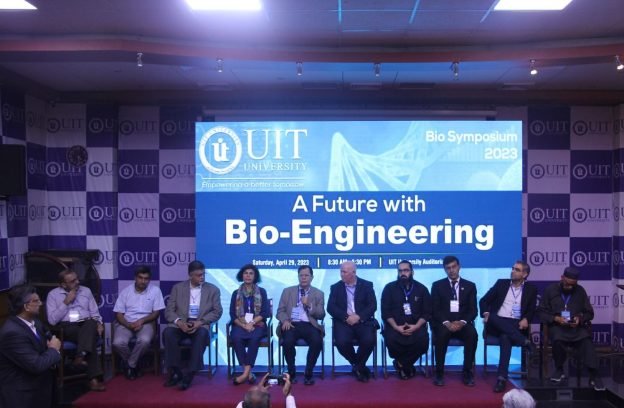
  • A Future with Bioengineering: UIT University Hosts National Symposium

    A Future with Bioengineering: UIT University Hosts National Symposium

    UIT University organized a one-day Symposium on Saturday 29th April, In the symposium guest speakers highlighted the recent developments in Genetic and Bio-engineering that are likely to bring drastic changes to society in the near future, much like how computer technology has transformed the world.
    The symposium brings together scientists, technologists, educationalists, students, and entrepreneurs to deliberate some of the amazing challenges and opportunities that are being unfolded with “Gene-editing”, “Synthetic biology” and “Engineering with biology”.
    The First National Symposium on Bio-Engineering, a full-day event with 18 distinguished speakers with foreign training, leading the discussions, covered application areas such as Agriculture, Health Sciences, and Engineering Materials. Educationalists proposed steps needed to introduce the subject at the school and college level, whereas business leaders were invited to explore economic opportunities for new startups and businesses.
    While addressing the symposium Chancellor of UIT University Mr. Hussain Hasham said that the World is changing very fast with new technologies that’s why UIT University is thinking about immerging in the new field of BioScience, Biotechnology, and bio Engineering.
    Sameer Hoodbhoy, Parvez Hoodbhoy, Dr. Athar Asama, Dr. Zahra Hasan, Dr. Shahpar Mirza, and Dr. Stephen Lyone were the guests at the symposium.

  • Over 75 pc of companies look to adopt latest technologies in next 5 years 14 million people will loose jobs in next five years, WEF Future of Jobs Report says

    Over 75 pc of companies look to adopt latest technologies in next 5 years 14 million people will loose jobs in next five years, WEF Future of Jobs Report says

    Economic, health and geopolitical trends have created divergent outcomes for labour markets globally in 2023. While tight labour markets are prevalent in high-income countries, low- and lower-middle-income countries continue to see higher unemployment than before the COVID-19 pandemic.
    On an individual level, labour-market outcomes are also diverging, as workers with only basic education and women face lower employment levels. At the same time, real wages are declining as a result of an ongoing cost-of living crisis, and changing worker expectations and concerns about the quality of work are becoming more prominent issues globally.
    The fourth edition of the Survey has the widest coverage thus far by topic, geography and sector. The Future of Jobs Survey brings together the perspective of 803 companies – collectively employing more than 11.3 million workers – across 27 industry clusters and 45 economies from all world regions.
    The Survey covers questions of macrotrends and technology trends, their impact on jobs, their impact on skills, and the workforce transformation strategies businesses plan to use, across the 2023-2027 timeframe.
    Technology adoption will remain a key driver of business transformation in the next five years. Over 85% of organizations surveyed identify increased adoption of new and frontier technologies and broadening digital access as the trends most likely to drive transformation in their organization. Broader application of Environmental, Social and Governance (ESG) standards within their organizations will also have a significant impact.
    The next most-impactful trends are macroeconomic: the rising cost of living and slow economic growth. The impact of investments to drive the green transition was judged to be the sixth-most impactful macro trend, followed by supply shortages and consumer expectations around social and environmental issues.
    Though still expected to drive the transformation of almost half of companies in the next five years, the ongoing impact of the COVID-19 pandemic, increased geopolitical divisions and demographic dividends in developing and emerging economies were ranked lower as drivers of business evolution by respondents.
    The largest job creation and destruction effects come from environmental, technology and economic trends.
    Among the macro trends listed, businesses predict the strongest net job-creation effect to be driven by investments that facilitate the green transition of businesses, the broader application of ESG standards and supply chains becoming more localized, albeit with job growth offset by partial job displacement in each case.
    Climate change adaptation and the demographic dividend in developing and emerging economies also rate high as net job creators. Technological advancement through increased adoption of new and frontier technologies and increased digital access are expected to drive job growth in more than half of surveyed companies, offset by expected job displacement in one-fifth of companies. The net job creation effect places these two trends in 6th and 8th place respectively.
    The three key drivers of expected net job destruction are slower economic growth, supply shortages and the rising cost of inputs, and the rising cost of living for consumers. Employers also recognize that increased geopolitical divisions and the ongoing impact of the COVID-19 pandemic will drive labour market disruption – with an even split between employers who expect these trends to have a positive impact and employers who expect them to have a negative impact on jobs.
    Within technology adoption, big data, cloud computing and AI feature highly on likelihood of adoption. More than 75% of companies are looking to adopt these technologies in the next five years. The data also shows the impact of the digitalization of commerce and trade. Digital platforms and apps are the technologies most likely to be adopted by the organizations surveyed, with 86% of companies expecting to incorporate them into their operations in the next five years. E-commerce and digital trade are expected to be adopted by 75% of businesses. The second-ranked technology encompasses education and workforce technologies, with 81% of companies looking to adopt these technologies by 2027. The adoption of robots, power storage technology and distributed ledger technologies rank lower on the list. The impact of most technologies on jobs is expected to be a net positive over the next five years. Big data analytics, climate change and environmental management technologies, and encryption and cyber security are expected to be the biggest drivers of job growth. Agriculture technologies, digital platforms and apps, e-commerce and digital trade, and AI are all expected to result in significant labour market disruption, with substantial proportions of companies forecasting job displacement in their organizations, offset by job growth elsewhere to result in a net positive. All but two technologies are expected to be net job creators in the next five years: humanoid robots and non-humanoid robots. Employers anticipate a structural labour market churn of 23% of jobs in the next five years. This can be interpreted as an aggregate measure of disruption, constituting a mixture of emerging jobs added and declining jobs eliminated. Respondents to this year’s Future of Jobs Survey expect a higher-than-average churn in the Supply Chain and Transportation and Media, Entertainment and Sports industries, and lower-than-average churn in Manufacturing as well as Retail and Wholesale of Consumer Goods. Of the 673 million jobs reflected in the dataset in this report, respondents expect structural job growth of 69 million jobs and a decline of 83 million jobs. This corresponds to a net decrease of 14 million jobs, or 2% of current employment. The human-machine frontier has shifted, with businesses introducing automation into their operations at a slower pace than previously anticipated. Organizations today estimate that 34% of all business-related tasks are performed by machines, with the remaining 66% performed by humans. This represents a negligible 1% increase in the level of automation that was estimated by respondents to the 2020 edition of the Future of Jobs Survey. This pace of automation contradicts expectations from 2020 survey respondents that almost half (47%) of business tasks would be automated in the following five years. Today, respondents have revised down their expectations for future automation to predict that 42% of business tasks will be automated by 2027. Task automation in 2027 is expected to vary from 35% of reasoning and decision-making to 65% of information and data processing. But while expectations of the displacement of physical and manual work by machines has decreased, reasoning, communicating and coordinating – all traits with a comparative advantage for humans – are expected to be more automatable in the future. Artificial intelligence, a key driver of potential algorithmic displacement, is expected to be adopted by nearly 75% of surveyed companies and is expected to lead to high churn – with 50% of organizations expecting it to create job growth and 25% expecting it to create job losses. The combination of macrotrends and technology adoption will drive specific areas of job growth and decline:
    The fastest-growing roles relative to their size today are driven by technology, digitalization and sustainability. The majority of the fastest growing roles are technologyrelated roles. AI and Machine Learning Specialists top the list of fast-growing jobs, followed by Sustainability Specialists, Business Intelligence Analysts and Information Security Analysts. Renewable Energy Engineers, and Solar Energy Installation and System Engineers are relatively fast-growing roles, as economies shift towards renewable energy. – The fastest-declining roles relative to their size today are driven by technology and digitalization. The majority of fastest declining roles are clerical or secretarial roles, with Bank Tellers and Related Clerks, Postal Service Clerks, Cashiers and Ticket Clerks, and Data Entry Clerks expected to decline fastest. – Large-scale job growth is expected in education, agriculture and digital commerce and trade. Jobs in the Education industry are expected to grow by about 10%, leading to 3 million additional jobs for Vocational Education Teachers and University and Higher education Teachers. Jobs for agricultural professionals, especially Agricultural Equipment Operators, are expected to see an increase of around 30%, leading to an additional 3 million jobs. Growth is forecast in approximately 4 million digitally enabled roles, such as E-Commerce Specialists, Digital Transformation Specialists, and Digital Marketing and Strategy Specialists.
    The largest losses are expected in administrative roles and in traditional security, factory and commerce roles. Surveyed organizations predict 26 million fewer jobs by 2027 in Record-Keeping and Administrative roles, including Cashiers and Ticket Clerks; Data Entry, Accounting, Bookkeeping and Payroll Clerks; and Administrative and Executive Secretaries, driven mainly by digitalization and automation.
    Analytical thinking and creative thinking remain the most important skills for workers in 2023. Analytical thinking is considered a core skill by more companies than any other skill and constitutes, on average, 9% of the core skills reported by companies. Creative thinking, another cognitive skill, ranks second, ahead of three self-efficacy skills – resilience, flexibility and agility; motivation and self-awareness; and curiosity and lifelong learning – in recognition of the importance of workers ability to adapt to disrupted workplaces.
    Dependability and attention to detail, ranks sixth, behind technological literacy. The core skills top 10 is completed by two attitudes relating to working with others – empathy and active listening and leadership and social influence – as well as quality control.
    Employers estimate that 44% of workers’ skills will be disrupted in the next five years. Cognitive skills are reported to be growing in importance most quickly, reflecting the increasing importance of complex problem-solving in the workplace. Surveyed businesses report creative thinking to be growing in importance slightly more rapidly than analytical thinking. Technology literacy is the third-fastest growing core skill. Self-efficacy skills rank above working with others, in the rate of increase in importance of skills reported by businesses. The socio-emotional attitudes which businesses consider to be growing in importance most quickly are curiosity and lifelong learning; resilience, flexibility and agility; and motivation and self-awareness. Systems thinking, AI and big data, talent management, and service orientation and customer service complete the top 10 growing skills. While respondents judged no skills to be in net decline, sizable minorities of companies judge reading, writing and mathematics; global citizenship; sensory-processing abilities; and manual dexterity, endurance and precision to be of declining importance for their workers. Six in 10 workers will require training before 2027, but only half of workers are seen to have access to adequate training opportunities today. The highest priority for skills training from 2023-2027 is analytical thinking, which is set to account for 10% of training initiatives, on average.


  • A Hub of Innovation and Opportunity

    A Hub of Innovation and Opportunity

    Silicon Valley is a region located in the southern part of the San Francisco Bay Area in California, United States. It is known for being a hub of technology and innovation, home to many of the world’s largest technology companies and startups.
    The name “Silicon Valley” comes from the fact that the region was originally known for its large number of silicon chip manufacturers, which were instrumental in the development of the modern computer industry.
    Today, Silicon Valley is more broadly used to refer to the entire tech industry and the many companies, entrepreneurs, and investors that make it thrive. Some of the most famous technology companies in the world are based in Silicon Valley, including Google, Apple, Facebook, and Tesla, among many others. The region is also known for its many venture capital firms, which fund and support new startups in the hopes of discovering the next big thing in technology.
    For young engineers and entrepreneurs from Pakistan, Silicon Valley offers a wealth of opportunities to learn, grow, and make a name for themselves in the tech industry. Many Pakistani engineers have already made their mark in Silicon Valley, working for some of the biggest and most innovative tech companies in the world.
    One of the biggest advantages of Silicon Valley for Pakistani young engineers is the abundance of high-paying tech jobs. The region is home to many of the world’s largest and most successful technology companies, which are always on the lookout for talented engineers and developers. Working for one of these companies can provide young engineers with valuable experience, exposure to cutting-edge technologies, and the opportunity to work alongside some of the brightest minds in the industry.
    In addition to traditional tech jobs, Silicon Valley is also a hotbed of entrepreneurship and innovation. Many young engineers and entrepreneurs from Pakistan have launched their own startups in Silicon Valley, taking advantage of the region’s supportive ecosystem of investors, mentors, and other resources. Whether it’s developing a new app, launching a hardware product, or solving a complex problem in a new and innovative way, Silicon Valley offers endless opportunities for young engineers to make their mark and build successful careers.
    Of course, there are also challenges associated with living and working in Silicon Valley. The region’s high cost of living can be a barrier for some, and competition for tech jobs can be intense. However, for those who are willing to take the leap and pursue their dreams in Silicon Valley, the rewards can be truly life-changing.
    Here are some brief examples of new innovations in process in Silicon Valley:
    Self-driving cars
    Augmented and virtual reality
    Artificial intelligence
    Sustainable energy
    Blockchain and cryptocurrencies
    These innovations have the potential to revolutionize transportation, entertainment, healthcare, finance, and more. As the technology industry continues to evolve, Silicon Valley is likely to remain at the forefront of innovation.
    In conclusion, Silicon Valley is a hub of innovation and opportunity, offering young engineers and entrepreneurs from Pakistan the chance to work for some of the world’s most innovative companies, launch their own startups, and make a name for themselves in the tech industry. While there are challenges associated with living and working in the region, the rewards can be immense for those who are willing to take risks and pursue their dreams in Silicon Valley.